On this page
- Begin with the community, not only the building
- The earlier Kingville school and campus development
- E.E. Waddell and the history of educational work
- Read desegregation and closure dates carefully
- The community-center chapter
- The 2025 marker expansion broadened public interpretation
- Oral history requires attribution and care
- Connect Kingville with the wider Albemarle story
A history of Albemarle is incomplete if it follows only downtown commerce, mills, and municipal growth. Kingville's institutions and community life are essential to the city's story. Education provides one important entry point, but the neighborhood's history also includes homes, organizations, recreation, relationships, and the work of preserving memory.
This guide introduces documented school history and the city's recent public interpretation. It also explains why dates and institutional names require care. A school can change grades, administration, name, buildings, and use over time; those changes do not always occur in one year or mean the same thing.
Begin with the community, not only the building
A school is a physical place, but its history includes students, teachers, families, and the organizations around it. A building-centered account can identify construction and alteration while missing the meaning the institution held for the people who used it.
That distinction is especially important when examining education under segregation. Unequal systems shaped opportunities and resources, while Black communities sustained institutions and relationships within those conditions. The goal of local history should be to document both the structural circumstances and the agency of the people whose lives were affected.
The earlier Kingville school and campus development
Stanly County's Kingville research page draws on historic-preservation work and identifies an earlier school associated with the Rosenwald era. It describes subsequent brick construction in the 1930s and provides architectural-history information about the campus now associated with 621 Wall Street.
Plans and construction records can reveal intended room arrangements, materials, and capacity. They should be compared with photographs and later accounts because a design is not always identical to the completed building. The county page also points to more recent research, a reminder that historical interpretation can develop as additional evidence is examined.
E.E. Waddell and the history of educational work
The county's account identifies E. E. Waddell as principal during the campus's development and describes elementary and high-school faculty under his supervision. It also records changes such as the 1949 incorporation of the elementary school into the Albemarle system and later campus additions.
These administrative facts provide a framework, but they are not the whole educational experience. Student work, yearbooks, programs, photographs, and oral histories can help explain daily routines, aspirations, extracurricular activity, and the relationships that made a school important to its community. Use them with attention to their dates and sources.

Read desegregation and closure dates carefully
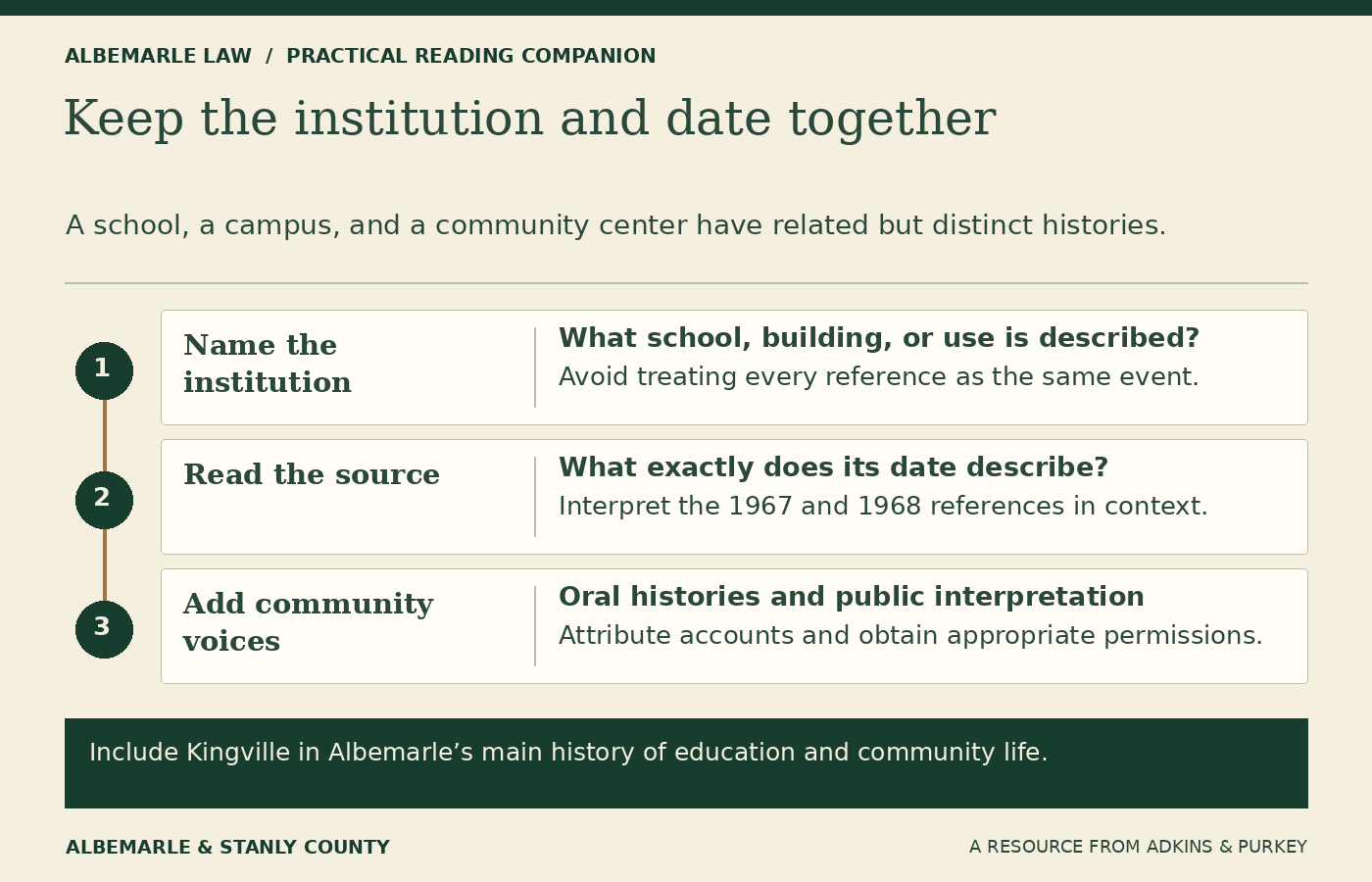
The city's community-center page identifies the former Kingville High School with a 1967 closing date. The county's broader historical account discusses system desegregation and the closure of South Albemarle School in 1968. Those statements should not be silently collapsed into one date for every aspect of the campus's transition.
When investigating the sequence, distinguish the named high school, the campus serving different grades, changes in administration, and later uses of the buildings. Consult the underlying records and updated preservation research for a detailed chronology. A careful account can acknowledge that sources describe different institutional events without pretending the distinction is already resolved by a short summary.
The community-center chapter
The E.E. Waddell Community Center connects the former school site with a continuing public role. Adaptive use can preserve a place's physical presence while changing what happens there. It also creates opportunities to explain earlier history to people who know the building primarily through its current activities.
When visiting, look for interpretation that identifies the earlier institution and the people associated with it. Confirm current access and programming with the city. A building in public use is not necessarily open for unscheduled historical tours of every space.
The 2025 marker expansion broadened public interpretation
In February 2025, Albemarle announced an expansion of its historic-marker program in collaboration with the Stanly County Historical Society and Stanly Avengers Inc. The listed Kingville subjects included the community, park, William Henry Wall, Kingville High School and the E.E. Waddell Center, and local social organizations. The city described markers linked to a digital story map through QR codes.
The official announcement shows a public effort to interpret more than a single prominent building. Markers can introduce a subject to new readers, while the linked sources and community collections allow a deeper investigation.
Oral history requires attribution and care
A recollection can preserve details that official records omit: how a teacher encouraged a student, where a community gathered, or how a transition felt to those experiencing it. Record the speaker's identity, the interview date, the event being discussed, and any permission governing use of the account.
Do not treat memory as either infallible or unimportant. Compare accounts and documents respectfully, and distinguish direct experience from stories passed along by others. Avoid placing words in a historical person's mouth or creating imagined quotations to make an article more dramatic.
Connect Kingville with the wider Albemarle story
Kingville belongs within the city's central history, not in a detached footnote. Read it alongside our Albemarle overview, the Stanly County history, and the discussion of Badin and West Badin. The comparison helps reveal both shared conditions and distinct community experiences.
The most useful next step is to follow one documented question into the sources: a school year, a building change, an organization, or a family connection. Local history becomes stronger when it makes those paths visible and preserves the evidence so that others can continue the work.
Explore with these questions
- Distinguish the school, campus, and later community-center uses
- Read the 1967 and 1968 references in their institutional context
- Attribute oral histories and obtain appropriate permissions
- Include Kingville within the main account of Albemarle
Questions readers ask
Where is the E.E. Waddell Community Center connected to this history?
The city identifies it with the former Kingville school site; the county research describes the campus at 621 Wall Street in Albemarle.
Why do sources mention both 1967 and 1968?
They describe different named institutions and stages of the school-system transition. Consult the cited city and county research rather than treating one year as a universal date for every event.
Continue reading
This community-education article is part of Albemarle Law’s separate history collection. For legal information, visit the family-law and estate-planning library. Explore additional regional writing at The Lake Norman Brief.
Attorney advertising. Historical and community information; confirm visitor information with the responsible organization. Illustrations are conceptual, not archival photographs. No attorney-client relationship is created by this page or an initial inquiry.