On this page

Badin offers a different starting point for Stanly County history. Where Albemarle developed around county government and later industry, Badin took shape around an ambitious project linking river power with aluminum production. Its streets and buildings help tell a story that reaches from the Yadkin River to France, wartime finance, American industry, and the daily lives of workers and their families.
The town should be explored as a living community, not simply an outdoor exhibit. Historic designation identifies significance; it does not make every house, industrial property, or landscape feature open to visitors. Begin with the Town of Badin's history and the Badin Museum, then confirm current access for any planned stop.
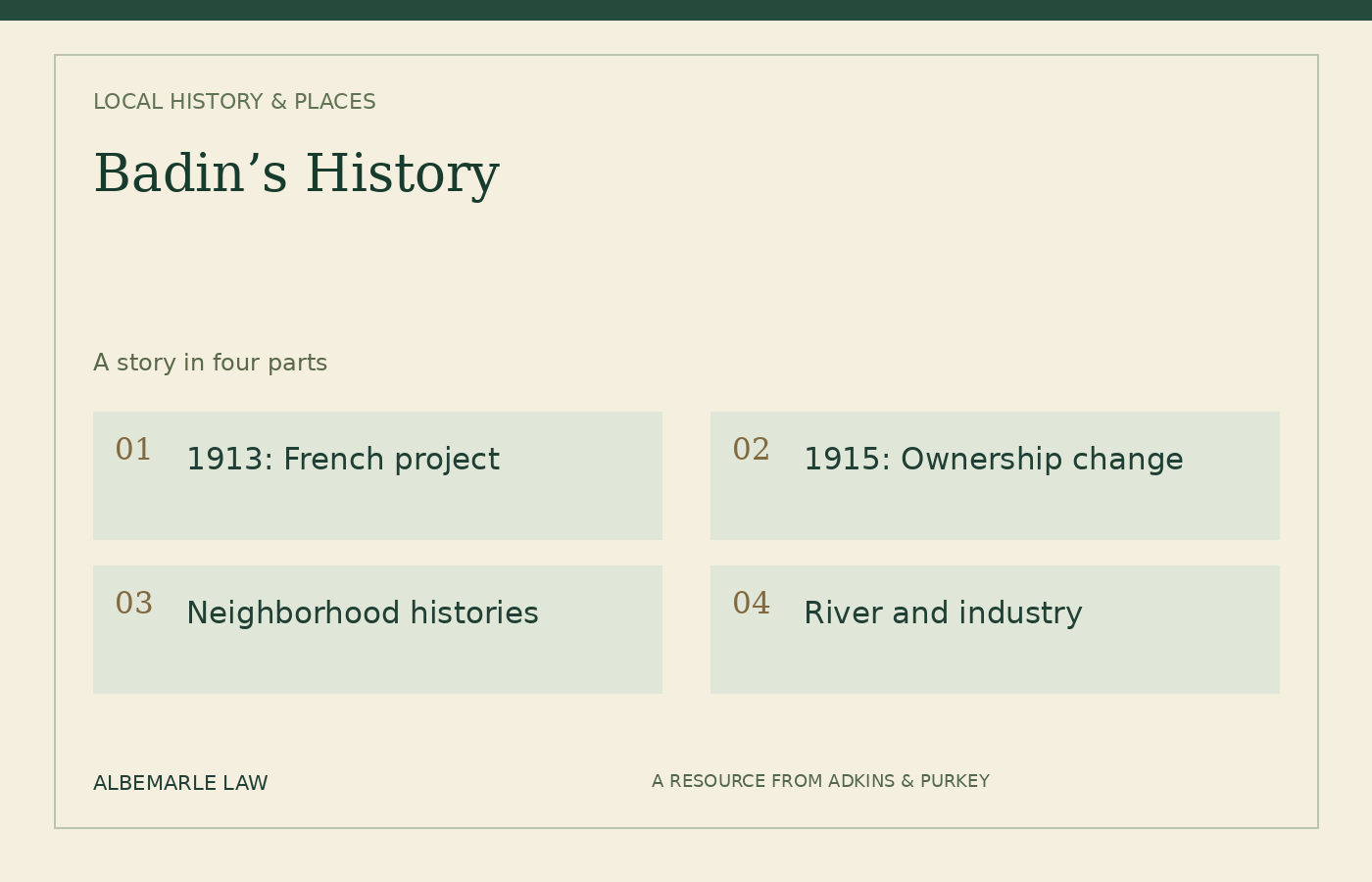
1913: An industrial vision arrived at the river
The town's account begins in spring 1913, when the French company L'Aluminium Français started work on a dam at the Yadkin River's narrows to supply an aluminum smelter. A town was planned for workers and engineers, and its name honored company president Adrien Badin. Power generation, manufacturing, and housing were conceived as connected parts of the same undertaking.
That connection explains why Badin cannot be understood solely through a factory building or a dam. Industrial production required people, and people required homes, services, and institutions. The resulting town plan expressed choices about how a workforce would live as well as how a product would be made.
World War I changed the project
The outbreak of war redirected the French company's financial resources. The town's history records the purchase of the partially completed development in November 1915 by American interests associated with the Aluminum Company of America. Work continued under a different corporate structure, but elements of the initial plan remained visible in the built environment.
This is a useful example of international events becoming local history. A war across the Atlantic affected financing and ownership in a small North Carolina community. When reading a local timeline, look for these wider connections rather than assuming the town developed independently of national or global conditions.
Architecture reflects planning and adaptation
Badin is known for features associated with its French origins, including distinctive residential forms and aspects of street and drainage design. The town's own account describes early houses, apartments, bungalows, and the former clubhouse now associated with the Badin Inn. The National Park Service record for the Badin Historic District documents its National Register recognition in 1983.
An architectural walk is most useful when it goes beyond style labels. Notice how a building meets the street, how entrances are arranged, how houses are grouped, and how the landscape accommodates changes in elevation. Then compare those observations with historic documentation. A present-day porch, window, or finish may reflect later alteration rather than original construction.
West Badin belongs in the account
The history of an industrial town includes the different conditions experienced by its residents. West Badin has its own National Register documentation and is associated with the community of Black workers and families. It should not disappear inside a generalized description of a picturesque company town.
A fuller interpretation asks how housing, education, services, and social life were organized during segregation, and how residents built community within those constraints. Consult the West Badin historic-district record and local museum resources. Describing attractive architecture is only one part of understanding the people who used it.
The river became an industrial landscape
Dam construction changed the relationship among water, land, and settlement. A modern lake view can make that transformation easy to overlook. Compare historical maps and accounts with present geography to understand where shorelines, routes, and uses changed.
Nearby Morrow Mountain State Park offers another perspective on the same regional landscape. Together, the park and Badin show why nature and industry should not be treated as unrelated subjects. The water and stone that shape the scenery also influenced work, movement, and decisions about land.

Read community history through more than company records
Corporate histories can explain ownership and production, but they do not capture every household's experience. School materials, photographs, oral histories, directories, and objects preserved by local institutions can add other viewpoints. Ask who created a record, why it was created, and whose activity it leaves out.
A photograph of a street, for example, can prompt questions about transportation, clothing, storefronts, and public space. An oral account can preserve the meaning of an event that an official report treats briefly. Use those sources together and keep a record of attribution so later readers can follow the evidence.
Plan a respectful visit and further reading
Start with museum or town information and choose a manageable theme: town planning, architecture, river power, or neighborhood life. Confirm opening times and accessibility directly. Stay off active rail and industrial property, and respect residents' privacy when viewing houses from public areas.
Badin's history adds depth to any account of Albemarle and Stanly County. It shows how a community can be shaped by a large industrial purpose while developing stories that exceed that purpose. Continue into our county history and Uwharrie landscape guide to place the town within the region's broader human and environmental history.
Explore with these questions
- Include West Badin and workers’ community life
- Compare present streets with historic documentation
- Confirm museum access and respect private residences
- Connect river history with industrial and social history
Questions readers ask
Why is the town called Badin?
The town’s official history identifies Adrien Badin, president of the French company behind the initial industrial project, as its namesake.
Does historic-district status allow visitors inside every building?
No. Many properties remain private or have specific access rules. Confirm permission and public opening information.
Continue reading
This community-education article is part of Albemarle Law’s separate history collection. For legal information, visit the family-law and estate-planning library. Explore additional regional writing at The Lake Norman Brief.
Attorney advertising. Historical and community information; confirm visitor information with the responsible organization. Illustrations are conceptual, not archival photographs. No attorney-client relationship is created by this page or an initial inquiry.