On this page
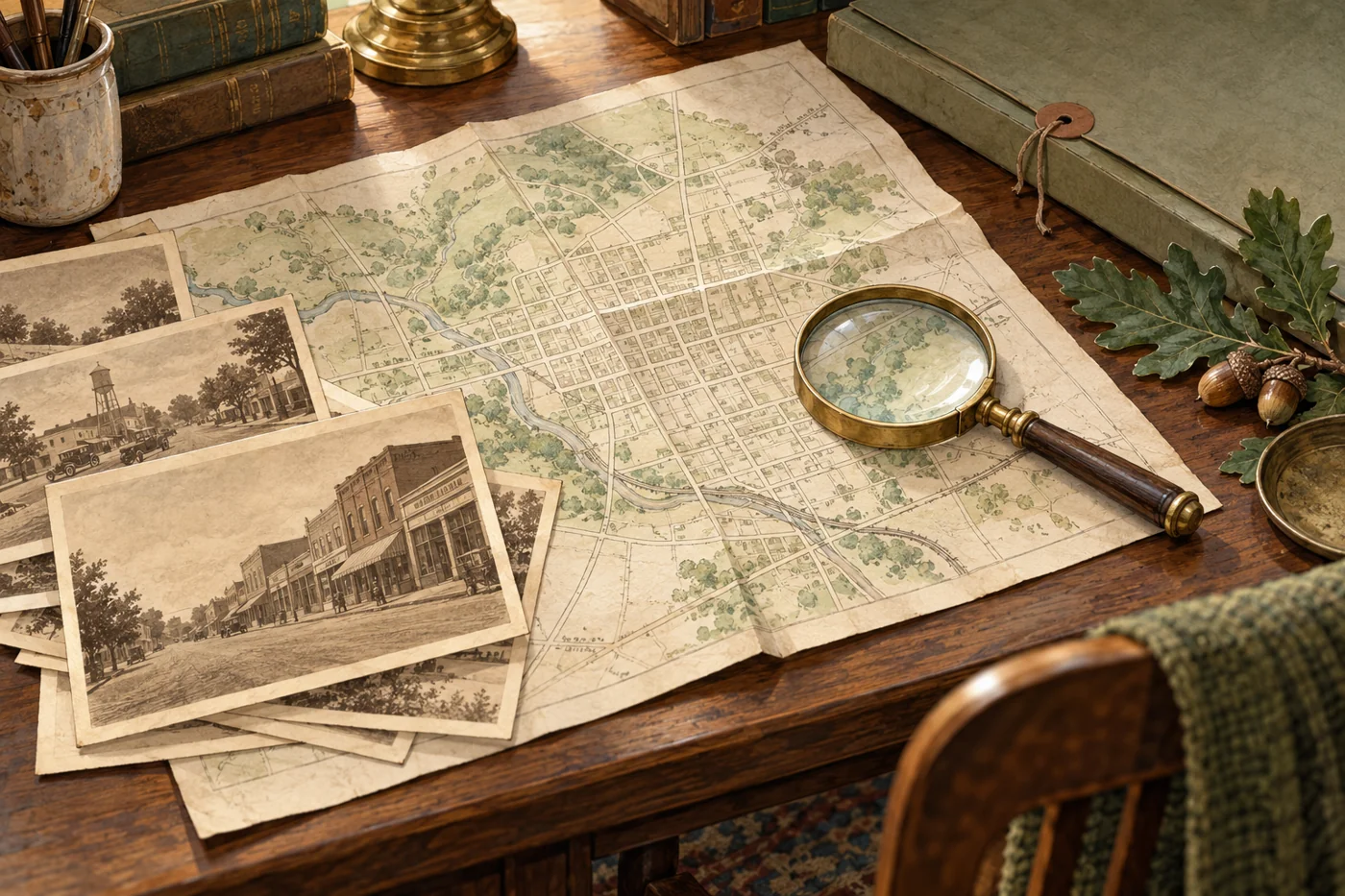
Albemarle's history is easiest to understand by looking at several maps at once. One shows the county boundary and the courthouse. Another follows the railroad and industrial sites. A third shows homes, schools, churches, and commercial streets. Together they explain how a small Piedmont county seat became a place with a much larger story than a single founding date can convey.
This article concerns the city of Albemarle in Stanly County. It should not be confused with the Albemarle Sound region of northeastern North Carolina, which appears in many searches for the same name. Keeping that distinction in mind is especially important when reading older newspapers and state-history collections.
1841: A new county needed a center
Stanly County was created from part of Montgomery County in 1841. The new county needed a permanent seat of government, and the settlement that became Albemarle developed around that role. The city's land-use history records that Nancy Allen Hearne donated 51 acres for the county seat near the meeting of important early roads. A courthouse was therefore not an incidental addition to the town; public business was part of the reason the town took shape.
Think about what a county seat meant before routine automobile travel. Court sessions, recordkeeping, trade, and personal business drew people into the same place. That recurring movement created opportunities for stores and services. The relationship between public institutions and private commerce remains a useful lens for reading Albemarle's downtown today.
1857: Incorporation and an older name
Albemarle was formally incorporated in 1857. Its name honors George Monck, Duke of Albemarle, one of the eight Lords Proprietors associated with the 1663 Carolina grant. The name thus reaches back to colonial government even though the Piedmont municipality developed much later. Naming and founding are separate historical questions: a seventeenth-century namesake does not make the town itself a seventeenth-century settlement.
The city's early economy was connected with agriculture and regional exchange. Albemarle's later industrial identity should not obscure those beginnings or the rural communities surrounding it. The county seat and the countryside developed in relationship with one another, and their histories remain intertwined.

1891 and the industrial turn
The Downtown Albemarle Historic District nomination identifies the arrival of the Yadkin Railroad in 1891 as a turning point. Rail connections helped make industrial expansion possible. Efird Manufacturing began operations in 1896, and Wiscasset Mills followed in 1899. Those dates mark more than new factories: manufacturing altered the demand for housing, stores, services, and transportation.
The same nomination describes a downtown in which substantial brick commercial buildings replaced earlier wooden structures. Look at upper-story windows, cornices, masonry patterns, and the proportions of storefronts. Even when a business name changes, a building can preserve evidence of the period in which commerce expanded. The street is an archive, but it works best when observations are checked against maps, photographs, and documentary sources.
Mill growth reached beyond the factory wall
The Pee Dee Avenue Historic District research follows industrial development into residential neighborhoods. It describes how the expansion of mills and related businesses can be traced through Sanborn maps, and how housing for workers, managers, and other residents reflected the growing industrial city. The Lillian Mills development in the early twentieth century forms another part of that account.
This wider view matters. A history made only of company founders and construction dates leaves out the routines of the people who worked in those institutions. Homes, walking routes, schools, and places of worship reveal how industrial growth shaped daily life. They also invite questions about differences in access, income, and opportunity within the same city.
Downtown and Five Points changed with the region
The Five Points Historic District nomination describes later shifts as shopping and professional activity moved beyond older commercial areas. Quenby Mall's development in 1960 is one marker in that account. Changes in retail patterns and the textile economy affected the uses of historic buildings and the way residents moved through the city.
A useful interpretation avoids describing the story as a simple rise, fall, and rescue. Buildings can pass through several uses, and different neighborhoods experience economic change differently. Historic preservation research helps identify those layers. A former store, office, or industrial building may tell several connected stories rather than represent one frozen moment.

Kingville and the history of education
Albemarle's history also requires attention to Black community life and the institutions shaped by segregation. The city identifies the E.E. Waddell Community Center with the former Kingville High School, which closed in 1967. State historic-preservation research on local schools provides additional context for the growth of the city's educational system and the separate facilities that served its students.
In 2025 the city's historic-marker program expanded to include Kingville subjects alongside downtown buildings. The announced subjects included Kingville community and park history, William Henry Wall, Kingville High School and the E.E. Waddell Center, and local social organizations. That expansion illustrates why the history of a city should continue to broaden as communities preserve and share their own records.
Reading Albemarle today
Begin with the official marker program and historic-district documentation rather than assuming every old-looking facade dates from the same era. Compare a building's present appearance with the nomination's description and historical photographs. Notice what survives, what changed, and what is missing. Respect private property and confirm public access before entering a site.
Albemarle's story connects institutions, industry, education, and family life. That is why a local history collection belongs alongside—but separate from—a resource about the decisions families make today. Continue into our Stanly County and Uwharrie articles to place the city within its broader setting, and use the linked primary resources to pursue the parts of the story that interest you most.
Explore with these questions
- Distinguish Stanly County’s Albemarle from the coastal Albemarle region
- Compare downtown buildings with historic-district documentation
- Include Kingville and school history in the story
- Confirm access and current visitor information with the responsible site
Questions readers ask
Was Albemarle founded in 1841 or 1857?
The county-seat settlement developed after Stanly County was created in 1841; formal municipal incorporation came in 1857. Those dates describe different stages.
Where should I start learning on a visit?
The city’s historic-marker program and the state’s historic-district nominations provide useful starting points. Check current access and visitor information before planning a stop.
Continue reading
This community-education article is part of Albemarle Law’s separate history collection. For legal information, visit the family-law and estate-planning library. Explore additional regional writing at The Lake Norman Brief.
Attorney advertising. Historical and community information; confirm visitor information with the responsible organization. Illustrations are conceptual, not archival photographs. No attorney-client relationship is created by this page or an initial inquiry.