On this page

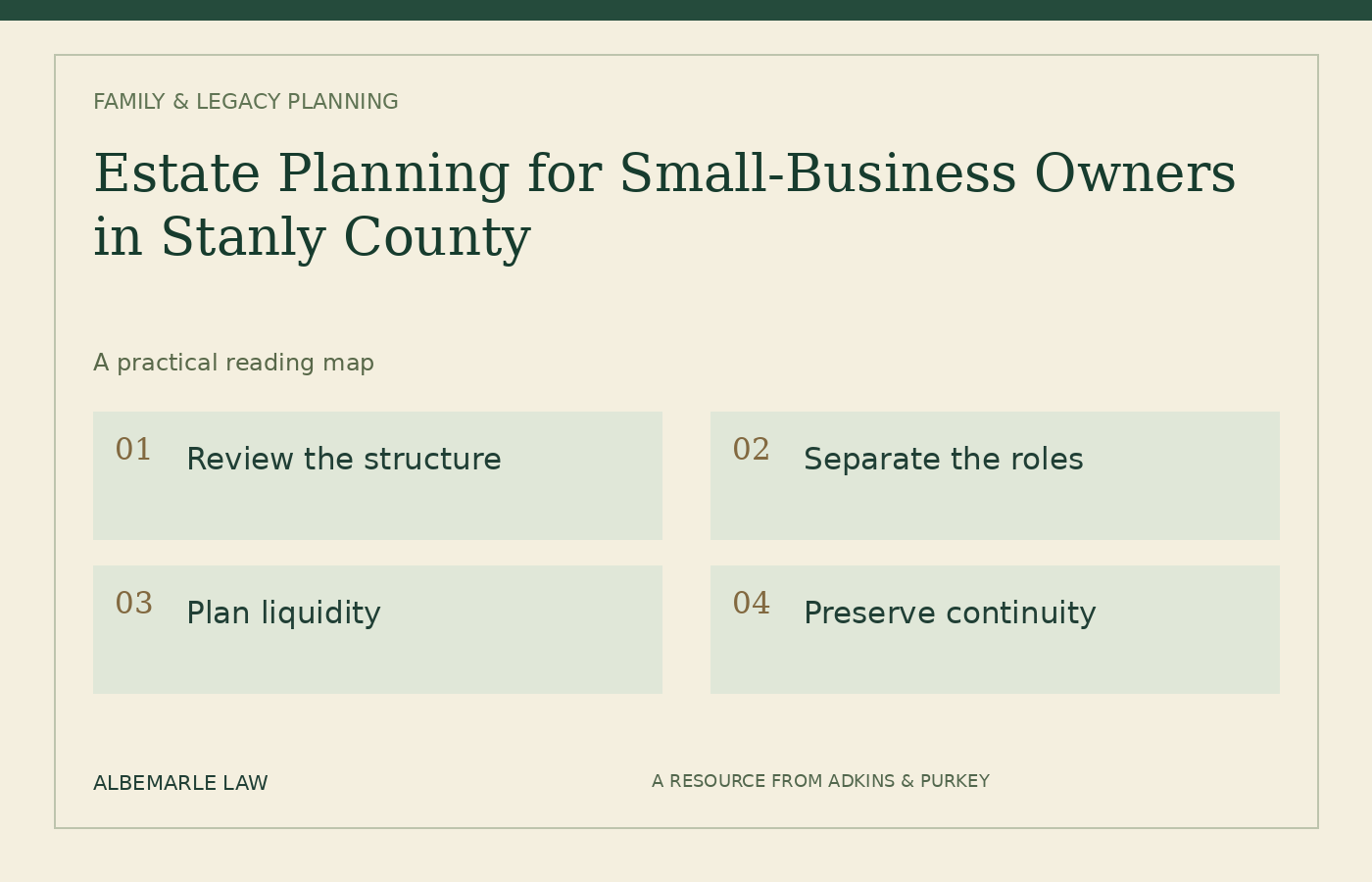
For a small-business owner, the estate plan may affect employees, customers, partners, and family members at the same time. A will can express intentions about ownership, but it may not answer who can run payroll tomorrow or who has authority under the company's existing agreements. Business continuity and personal planning need to be reviewed together.
Identify the business and its governing documents
Bring formation documents, operating or shareholder agreements, buy-sell arrangements, ownership records, and any amendments. Identify the business's legal form and who owns each interest. Informal descriptions such as family business or partnership may not accurately describe the legal structure.
Transfer restrictions and contractual rights can limit what a will or trust can accomplish. Do not assume an ownership interest can pass to any chosen person on any terms. Have the business documents reviewed before relying on a proposed estate gift.
Separate ownership from management
The person intended to inherit the business may not be ready or able to operate it immediately. Conversely, the best interim manager may not be the intended long-term owner. Decide which roles are needed during incapacity, after death, and during any sale or transition.
Consider who can communicate with banks, vendors, employees, and advisers. Authority may arise from company documents, a power of attorney, a trust, or estate administration, depending on the issue. A single document may not cover every operational need.
Plan for cash needs and valuation
A business interest may be valuable without being easy to convert to cash. Family support, payroll, debt payments, and estate expenses can create competing demands. Review insurance and reserves with appropriate financial advisers, and understand whether any buy-sell funding matches the actual agreement.
If a valuation method is part of the arrangement, ask whether it remains workable and current. An old fixed price can become disconnected from the business. Tax questions and the treatment of particular assets require individual advice; avoid assuming a generic succession template resolves them.
Document the knowledge only you hold
Create a secure operations guide identifying key contacts, recurring obligations, important contracts, and the location of records. Include digital platforms, domains, payment systems, and authorized administrators. Preserve security while reducing dependence on one person's memory.
The guide should explain where information can be found and who has authority to act. It should not encourage others to impersonate you online or use access beyond their legal role. Coordinate the digital plan with the company's procedures and your personal estate documents.

Align the business plan with family expectations
If one child works in the business and another does not, an equal division of ownership may create difficult decisions. Discuss whether equality of value, shared control, or a different arrangement best serves the goals. Consider the interests of a spouse, co-owners, and anyone dependent on business income.
Review the plan after a new partner, significant borrowing, acquisition, ownership transfer, or change in family circumstances. A Stanly County business consultation should connect legal structure with practical continuity. The aim is to give responsible people both a plan and the authority to carry it out when the owner cannot.
Bring these to the conversation
- Formation and ownership documents
- Operating, shareholder, and buy-sell agreements
- Key contracts, debts, and insurance
- Interim management and digital-access plan
Questions readers ask
Is a will enough to keep a business operating?
Usually more coordination is needed. Management authority, company agreements, access, liquidity, and transition procedures must also be considered.
Can my trust own my business interest?
That depends on the entity, governing agreements, tax considerations, and transfer restrictions. Review the specific interest before transferring it.
Continue reading
Explore more guidance through Adkins & Purkey, the Lake Norman Brief, and Adkins Law in Huntersville. These resources do not replace advice about your individual case.
Attorney advertising. General legal information, not legal advice. Laws and procedures can change. Every matter requires individual review. Illustrations are conceptual and do not depict actual clients. No attorney-client relationship is created by this page or an initial inquiry.