On this page

Gold is an attention-grabbing way to begin a local history, but the most interesting questions come after the discovery. Who supplied capital? How did work change? What happened when a mine became expensive to operate? Which institutions remained after the immediate excitement passed? New London and the wider Stanly County gold story offer a useful way to explore those questions.
This guide distinguishes the history of New London from other mining sites in the region. The Parker Mine, Barringer Mine, Reed Gold Mine, and Gold Hill should not be treated as interchangeable names for one place. County boundaries and the dates of records also matter, especially when following a story that began before Stanly County's creation in 1841.
Bilesville before New London
The Town of New London's history traces the community's beginnings as Bilesville around 1830, associated with Thomas Biles Jr. and Elizabeth Betsy Sides Biles. The later name reflects a different stage of development. A settlement can have a community identity, a post office, industries, and institutions before formal municipal incorporation.
For researchers, an earlier place name is a search tool. Look for both Bilesville and New London when examining maps, newspapers, family papers, and business records. Record the date attached to each name rather than replacing every historical reference with the modern label.
The Parker Mine and outside investment
The town's account associates gold discovery on the Howell Parker farm with 1859 and describes later investment by New London & States Co., Ltd. in the 1870s. It connects the proposed new town name with company representative W. A. Judd and the expectation of future growth. New London was formally incorporated on March 25, 1891.
Those facts reveal a community looking outward as well as inward. Mining could connect local land to outside capital and ambitious expectations. They also invite a distinction between promotional hopes and documented results. A prediction that a town would become large is evidence of aspiration, not proof of what actually happened.
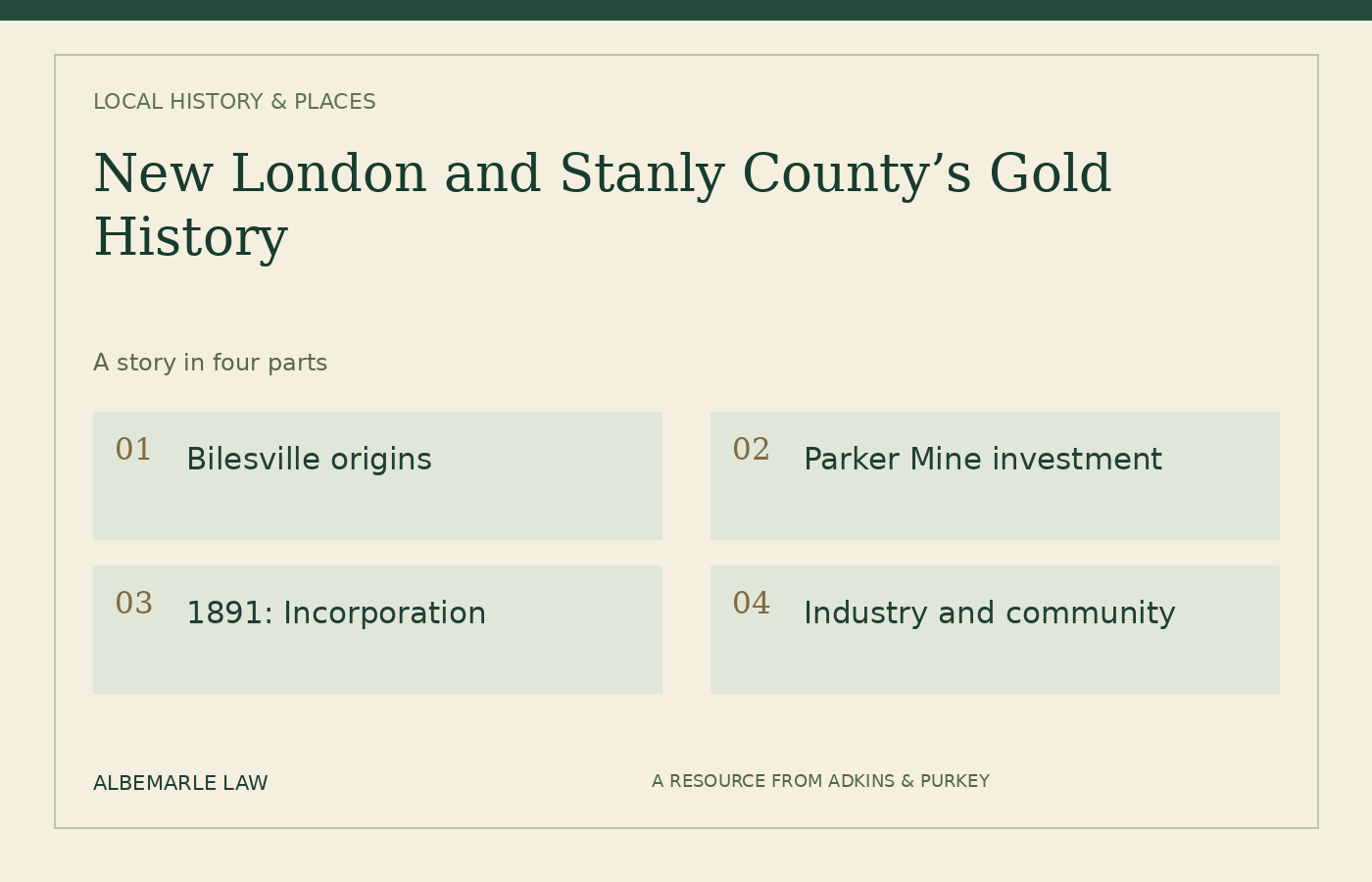
Mining was only one part of the economy
The municipal history also identifies cordage, brick, and lumber enterprises. That broader industrial picture matters because a town's survival and identity need not depend on a single mine. Schools, churches, stores, services, and homes could continue to shape community life through changes in mining activity.
Ask how different kinds of work fit together. A business directory may reveal occupations that a short gold-rush narrative overlooks. Family photographs and school records can show continuity across periods when industrial accounts emphasize openings, closings, or changes in ownership.
Barringer and the shift below ground
The state's Barringer Mine marker research identifies a significant 1825 discovery of gold-bearing quartz in what is now Stanly County. Its importance lies in the development of vein, or lode, mining. That method differs from recovering material deposited in streams through placer mining.
The distinction is more than technical vocabulary. Following a vein into the ground changed the equipment, labor, investment, and risks associated with mining. Use the state research and geological resources to understand those processes rather than assuming every historic mine consisted of people panning beside a creek.
Keep neighboring gold sites in their proper places
Reed Gold Mine is in Cabarrus County, while the Gold Hill district is associated with southeastern Rowan County. Both are relevant to regional history, but neither should be relocated into Stanly County for the sake of a simpler story. The North Carolina Geological Survey's gold resources provide a broader geographic framework.
Dates can also differ among summaries when they refer to discovery, first workings, a later operation, or a company's formation. If sources disagree, identify the event each date describes and favor specific documentary research over an unsupported repeated claim. Do not collapse all stages into one founding date.
Museums preserve the community around the industry
The town identifies the New London Area Historical Museum at 226 South Main Street as a place to explore local history. Confirm current opening information through the official town website before visiting. Museum objects and photographs can help connect the industrial account with family and civic life.
A useful visit begins with a question: how did a particular trade operate, what did a street look like, or how did a family participate in local institutions? Record object labels and source information. If you have family materials to share, ask the institution about its donation or copying policies rather than leaving unidentified items without context.
Learn without entering historic mine sites
Historical significance does not imply safe or authorized public access. Old workings may be on private property and can present serious hazards. Use official museums, marked interpretation, and authorized visitor sites; do not enter shafts, tunnels, or restricted land based on an online story.
New London's history is most rewarding when the gold story becomes a doorway into a larger account of work, investment, transportation, and community persistence. Continue with our Stanly County overview and Albemarle history to compare the different forces that shaped nearby places.
Explore with these questions
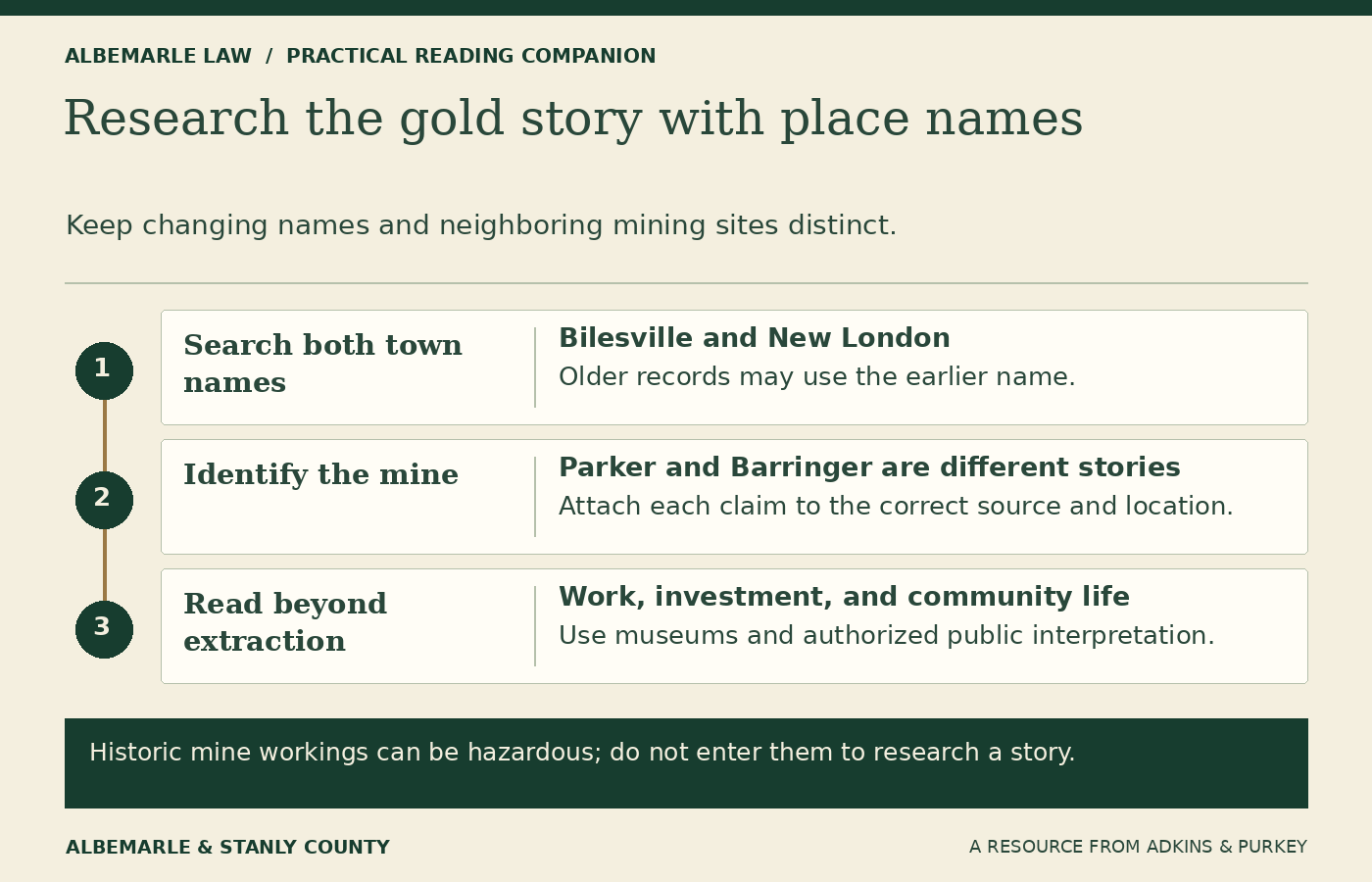
- Search both Bilesville and New London in older records
- Distinguish the Parker and Barringer mining stories
- Keep Reed and Gold Hill in their correct neighboring counties
- Use authorized interpretation and avoid old mine workings
Questions readers ask
When was New London incorporated?
The town’s official history gives March 25, 1891.
Is Reed Gold Mine in Stanly County?
No. Reed Gold Mine is in neighboring Cabarrus County. It is part of the broader regional gold story.
Continue reading
This community-education article is part of Albemarle Law’s separate history collection. For legal information, visit the family-law and estate-planning library. Explore additional regional writing at The Lake Norman Brief.
Attorney advertising. Historical and community information; confirm visitor information with the responsible organization. Illustrations are conceptual, not archival photographs. No attorney-client relationship is created by this page or an initial inquiry.