On this page
- Plan the exception before the next holiday arrives
- Make shared care practical for the child
- Discuss lake days and travel as ordinary parenting details
- Separate the child-support discussion from disputed purchases
- Create an ownership history for land and larger assets
- Budget for use, upkeep and a possible transition
- Connect the family-law plan with longer-term instructions

A family schedule that works during an ordinary week can unravel around a long weekend, a summer trip or a change in housing. For Norwood parents and separating spouses, careful planning means looking beyond the immediate disagreement. The goal is to make responsibilities understandable: who is caring for the child, which schedule controls, what information must be shared and how household obligations will be documented.
The Town of Norwood describes its setting beside Lake Tillery and the Pee Dee and Rocky rivers in southeastern Stanly County. NC OSBM's July 1, 2024 estimate placed the municipal population at 2,477. This lakes-and-rivers setting provides context for a practical family-law guide; it does not create different custody or divorce rules. Adkins & Purkey serves Norwood residents from 217 W. Main Street, Locust.
Plan the exception before the next holiday arrives
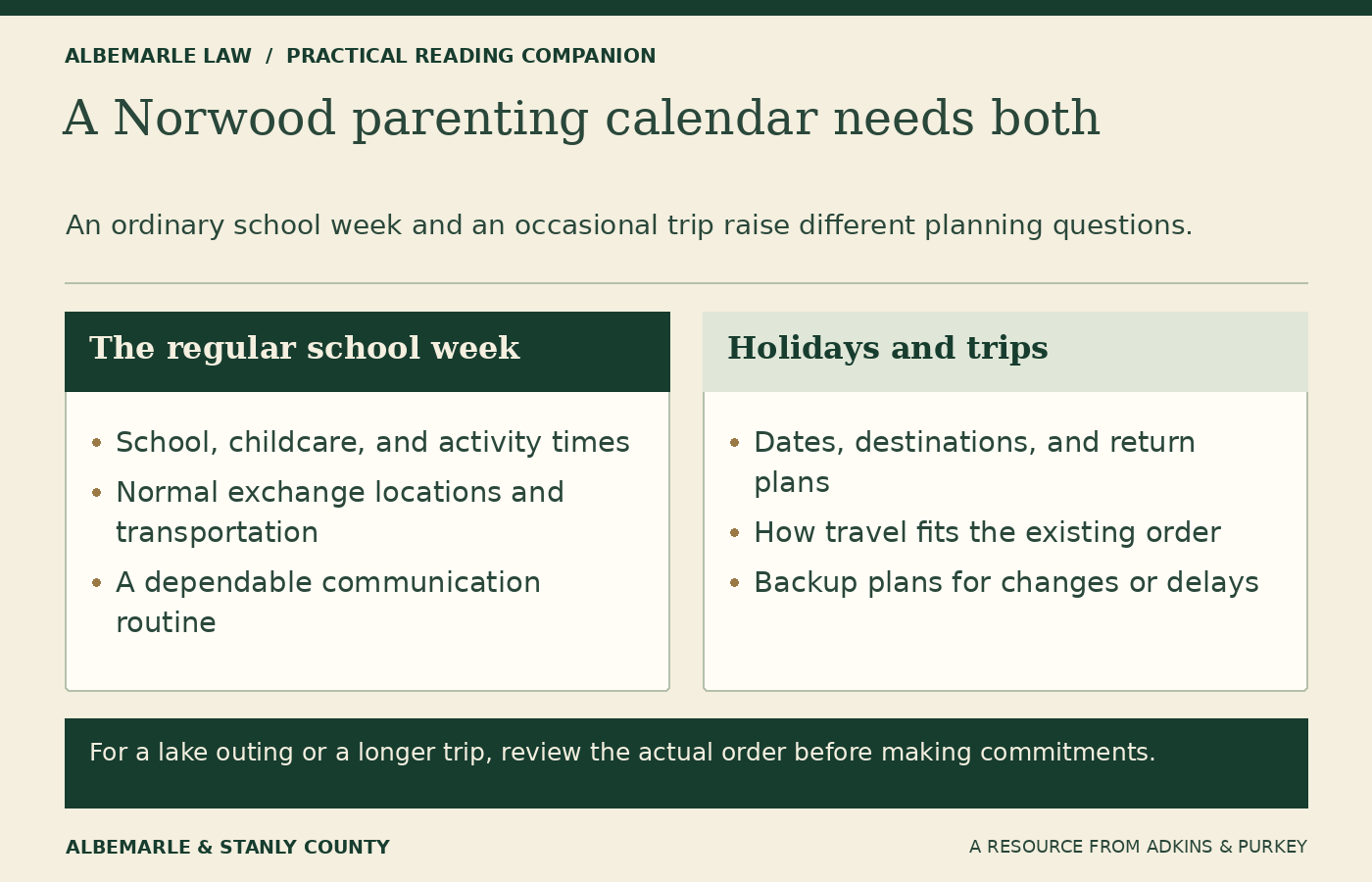
Take a calendar and mark ordinary parenting days in one color. Add school breaks, holidays, travel and recurring family commitments in another. Identify overlaps. A weekend arrangement may conflict with a holiday provision, and a summer vacation request may cover an exchange already scheduled. Start with the language of any existing order; do not assume that the most recent text message replaces it.
For a proposed plan, define the start and end of each special period and explain how the ordinary rotation resumes. Consider the difference between an overnight visit and an entire holiday weekend. Ask counsel to help resolve ambiguous wording before making nonrefundable reservations. If the adults agree on a one-time change, discuss an appropriate written record and whether a more formal change is needed. A convenient exception should not become a recurring source of uncertainty.
Make shared care practical for the child
Write down school departure times, transportation responsibilities, medication routines and contact information for important caregivers. Include what happens if a parent is delayed, a child becomes ill or an activity is cancelled. A grandparent's willingness to help may be valuable, but describe that assistance accurately rather than assuming it is always available. Keep the child out of negotiations about who caused a scheduling problem.
North Carolina custody decisions turn on the child's interests and welfare. The Judicial Branch's custody guide also distinguishes physical care from authority over major decisions. A calendar therefore needs an accompanying conversation about schooling, medical care and information sharing. Our child custody and support page connects these subjects, while the Stanly County family-law guide provides a broader starting point.
Discuss lake days and travel as ordinary parenting details
In a family that spends time near Lake Tillery or the rivers, planning may include boating outings, visits with relatives or a weekend at another household. Identify who will supervise, where the child will stay and how the other parent can make appropriate contact. Discuss equipment, transportation and any particular medical or safety needs. These are examples of practical topics, not a claim that every Norwood family has the same activities or risks.
An address matters more than an informal description such as 'at the lake.' If travel involves a different state, a school absence or a restriction in an order, ask counsel before committing. Maintain a workable way to communicate changes without requiring the child to carry messages. For a larger change in residence, see our relocation checklist rather than assuming a vacation arrangement answers the legal questions about moving.
Separate the child-support discussion from disputed purchases
A disagreement about recreation costs can become confused with a support obligation. Gather the existing order, payment history, income information and records of recurring child-related expenses. List school costs, childcare, insurance and optional activities separately. Ask which expenses are addressed by an order, which require consultation or agreement, and how reimbursement requests should be documented.
Avoid using a child's schedule to settle an argument about money. The court's custody information explains that parenting rights do not simply depend on whether support has been paid. Keep advice about enforcement, support calculations and custody in their proper contexts. The child-support records guide offers a focused list of financial material to organize for counsel.
Create an ownership history for land and larger assets
If a household owns a residence, an undeveloped parcel, a boat, a business interest or property used by extended family, create a separate record for each asset. Identify the current title, acquisition date, purchase price, funding source, loans and later improvements. Retain closing papers, relevant account statements and documents concerning gifts or inheritances. Explain informal arrangements, such as a relative paying a repair bill, without assuming what legal effect they have.
North Carolina's equitable-distribution statute distinguishes marital, separate and divisible property. Classification and valuation can require more than the name on a deed or an owner's estimate. Records tracing money into improvements or debt reduction may help counsel examine the history. Do not transfer property, change ownership or promise a buyout based only on an online summary. Obtain advice about the particular asset and any pending claims.
Budget for use, upkeep and a possible transition
An asset's market value is only one practical question. List the expenses of keeping it: debt payments, insurance, taxes, repairs, storage and utilities where applicable. If one spouse proposes to retain it, examine the actual monthly cost and any financing assumptions. Ask who will preserve records and handle necessary maintenance while the legal issues remain unresolved. Separate urgent preservation work from elective improvements that can wait for discussion.
For shared household contents, a dated inventory can reduce disagreement about what exists and where it is kept. Photograph items lawfully, record serial numbers where useful and avoid assigning speculative values. Distinguish sentimental preferences from financial figures. An organized record gives a lawyer a more useful starting point than a broad statement that one person should receive 'everything at the house.'
Connect the family-law plan with longer-term instructions
A separation or changed caregiving arrangement is a reason to review estate planning with appropriate advice. Bring existing wills, powers of attorney and beneficiary information to the discussion. Identify anyone who depends on you, including children from an earlier relationship or an adult who needs assistance. Ask how contemplated changes interact with current orders and agreements before altering documents or account instructions.
Norwood's community story belongs in our separate history of Norwood article; this guide concentrates on today's family decisions. For an individual review of custody, support, separation or property concerns, visit our family-law resource page and request a consultation with Adkins & Purkey. Call or text (704) 880-9388 and identify any hearing or response deadline. Confirm representation and the next required action with the firm; sending an inquiry alone does not arrange a court appearance.
Bring these to the conversation
- Existing orders plus a calendar of overlapping holidays and travel
- School, caregiver, transportation and medical contact information
- Titles, acquisition records and funding history for significant assets
- Household expense records, support history and questions for counsel
Questions readers ask
Can we change a holiday schedule through a text message?
The effect depends on the order and circumstances. Discuss a proposed exception with counsel and document it appropriately. Do not assume an informal exchange permanently modifies a court order.
Is property in only one spouse's name automatically excluded from divorce?
No. Title alone does not answer every classification question. Counsel should examine acquisition, source of funds, agreements and the applicable law before drawing a conclusion.
Where can Norwood residents meet with Adkins & Purkey?
The firm serves Norwood families through its office at 217 W. Main Street in Locust. Call or text (704) 880-9388 to discuss available consultation arrangements.
Continue reading
Explore more guidance through Adkins & Purkey, the Lake Norman Brief, and Adkins Law in Huntersville. These resources do not replace advice about your individual case.
Attorney advertising. General legal information, not legal advice. Laws and procedures can change. Every matter requires individual review. Illustrations are conceptual and do not depict actual clients. No attorney-client relationship is created by this page or an initial inquiry.