On this page

A custody order that worked when a child was young may become difficult as school, work, health, and family circumstances change. The legal question is not simply whether a parent now prefers a different arrangement. For a permanent North Carolina custody order, counsel generally must examine a substantial change in circumstances affecting the child's welfare and whether the proposed change serves the child's best interests.
Begin with the actual order
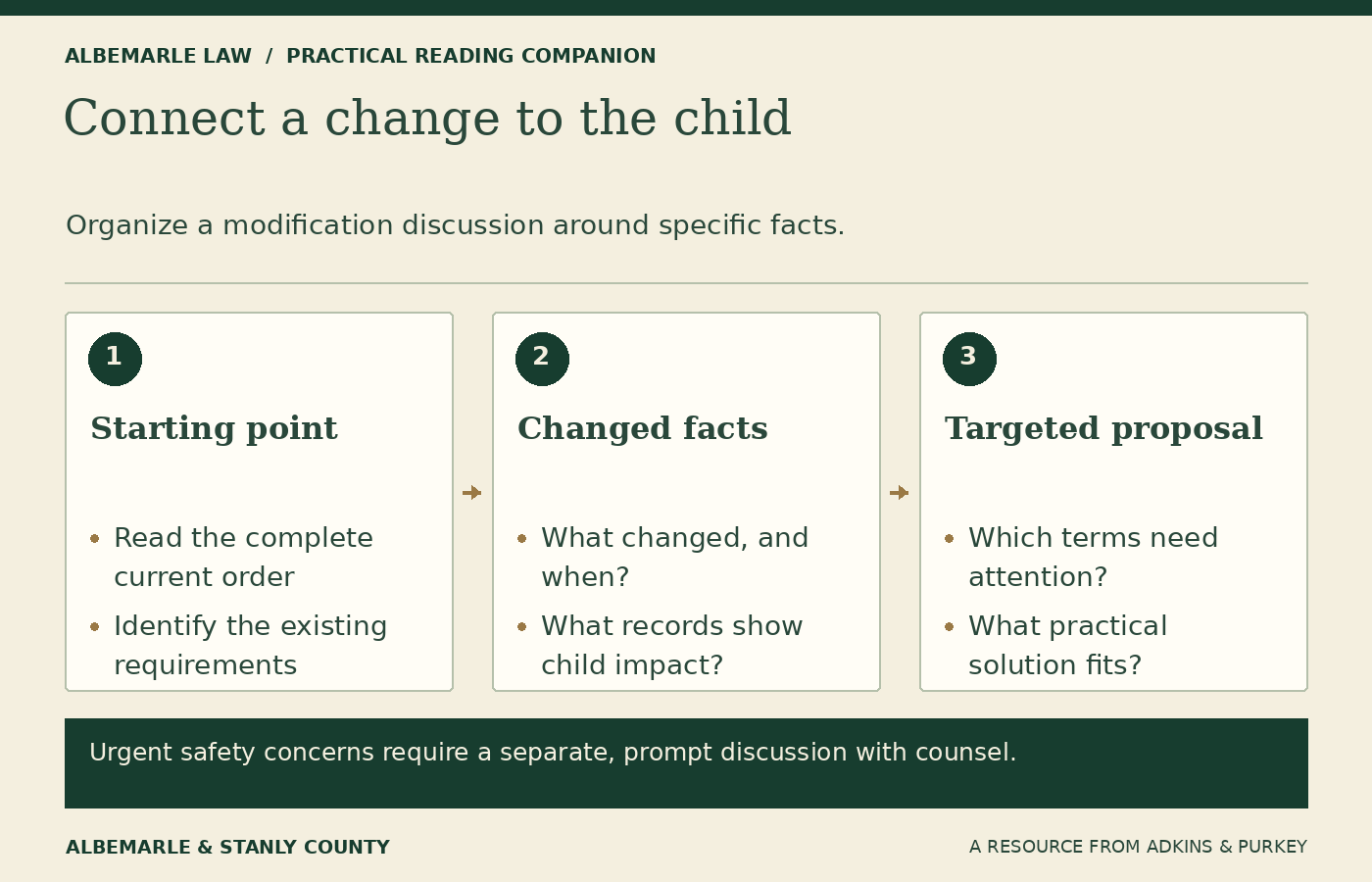
Bring the complete signed order, including incorporated schedules and attachments. Identify whether it is temporary or permanent; that distinction can affect the applicable analysis. Read the provisions about exchanges, school, travel, communication, and dispute resolution. A problem may involve interpretation or enforcement rather than modification. Your lawyer needs the exact language before recommending a route.
Describe what changed and when
Create a chronology beginning with the order's entry. A new work schedule, repeated transportation failures, a child's changed medical needs, or a proposed move should be described with dates and supporting information. Explain what is different from the circumstances the court previously addressed. Avoid treating every disagreement as proof that the whole arrangement should be replaced.

Connect the change to the child
The effect on the child is central. Has attendance suffered? Are medical appointments repeatedly missed? Does the schedule interfere with a documented need? Provide objective records when available and identify witnesses with firsthand knowledge. Separate the child's experience from a parent's frustration. Do not coach a child, rehearse testimony, or place the child in the middle of collecting evidence.
Keep a measured record
A dated log can identify patterns, but it should be accurate and specific. Record what happened, who was present, and what source supports the entry. Preserve complete messages rather than selected fragments. Note successful exchanges as well as problems so the record is credible. Ask counsel how to preserve private school or medical information and how it should be shared securely.
Propose a targeted solution
A practical request explains what language should change and why. If the problem is an exchange time after a work change, propose a feasible alternative and account for transportation. If the concern is broader, explain how a different schedule addresses it. Consider whether negotiated revisions are possible, but do not assume an informal agreement replaces a court order.
Address urgent situations separately
An emergency may require a different response than an ordinary modification request. Immediate danger should be directed to emergency services. Discuss serious safety concerns promptly with counsel; do not assume they can wait for a routine calendar setting. Adkins & Purkey can review an Albemarle or Stanly County family's existing order, chronology, and proposed solution to help identify the next legal step.
Bring these to the conversation
- Complete signed order and attachments
- Chronology of changes since entry
- Records showing effects on the child
- Specific proposed changes and backup options
Questions readers ask
Can I stop following an order because circumstances changed?
Do not assume that you can. Obtain advice about the order, any immediate safety issue, and the available court procedure.
Does a child’s preference decide the outcome?
A child’s wishes may be relevant depending on the circumstances, but the court’s analysis is broader. Avoid promising a child that choosing a household will control the result.
Continue reading
Explore more guidance through Adkins & Purkey, the Lake Norman Brief, and Adkins Law in Huntersville. These resources do not replace advice about your individual case.
If a separate DWI charge overlaps with your family concerns, LKN DWI Defense explains that distinct process. A criminal allegation does not by itself decide a custody issue.
Attorney advertising. General legal information, not legal advice. Laws and procedures can change. Every matter requires individual review. Illustrations are conceptual and do not depict actual clients. No attorney-client relationship is created by this page or an initial inquiry.