ADKINS & PURKEY, PLLC · ALBEMARLE & STANLY COUNTY
Legal sources checked November 11, 2026 · General North Carolina information
Estate planning begins with ordinary questions: who could pay the bills if you were unable to act, who should care for a child, how should a home pass to the next generation, and where would the family find reliable instructions? For Albemarle households, a useful plan connects those decisions with actual property and legal authority. Choosing a document called a will or trust is only part of the work.
Adkins & Purkey, PLLC provides this guide to help Albemarle and Stanly County readers prepare for a planning consultation. Chris Adkins and Chris Purkey serve the area from the firm's Locust office. The goal is a coordinated arrangement that reflects the person's wishes, satisfies legal requirements, and can be carried out. The appropriate tools depend on family circumstances, ownership, benefits, taxes, incapacity concerns, and practical administration.

Begin with people and decisions
List the people who depend on you, the people you want to benefit, and the people who could responsibly act. Marriage, prior relationships, stepchildren, minor children, disability, estrangement, and shared ownership can change the choices. A document designed for one household may produce an unintended result in another.
Identify the decisions that matter during life as well as at death. Financial management, health care, access to records, business continuity, and housing can become urgent before anyone needs an inheritance document. Ask prospective decision makers whether they are willing and able to serve. Naming a trusted person is useful only if the person understands the role and can obtain the necessary information and authority.
Inventory ownership and beneficiary arrangements
Create a list of real estate, bank accounts, investments, retirement benefits, insurance, vehicles, business interests, debts, and important digital assets. Record how each asset is owned, whether a beneficiary is designated, and where the governing documents are kept. Exact account credentials do not belong in an ordinary planning worksheet sent by email.
The form of ownership can determine the transfer route. Property with valid survivorship rights or a beneficiary designation may pass outside a will, subject to applicable law. Joint access and survivorship are not interchangeable concepts. A deed, account agreement, or plan record is more reliable than a family's assumption that two names mean the survivor automatically owns everything.
Understand what a will controls
A valid will directs the disposition of property it legally governs at death. It can nominate an executor, identify beneficiaries and backups, address the remaining estate through a residuary clause, and include trusts or other provisions. It does not generally replace every beneficiary designation or ownership arrangement.
Having a will does not by itself avoid probate. The will ordinarily must be probated to establish its legal effect, and administration may be needed for assets it controls. A will can remain useful even when substantial property passes another way. The North Carolina Judicial Branch's estate resource explains the distinction between probate assets, nonprobate transfers, wills, trusts, and fiduciaries.
Execution is a legal requirement, not a finishing detail
North Carolina generally allows a person age 18 or older with sufficient testamentary capacity to make a will. For an ordinary attested written will, the statute requires signing or an authorized directed-signature procedure and at least two competent witnesses, with specific presence and acknowledgment rules. A notary alone does not replace the witnesses.
The attested-will statute requires the witnesses to sign in the testator's presence; they need not sign in each other's presence. Properly completed self-proving documentation can help with later proof, but does not cure every defect. Do not assume an electronic signature, video call, or handwritten edit satisfies the requirements for the document being used.
A handwritten note is not automatically a valid will
North Carolina recognizes holographic wills when statutory handwriting and signature conditions are satisfied. The former special custody or discovery requirement was repealed in 2021 for the estates covered by that amendment. That change does not make every handwritten expression of wishes legally effective. Proof can become difficult when the original cannot be found or the document's purpose is disputed.
An attorney-prepared and properly supervised plan can reduce avoidable uncertainty about beneficiaries, execution, authority, and coordination. A power-of-attorney agent cannot simply make the principal's will using general financial powers. If physical assistance or capacity concerns exist, discuss them before signing so counsel can address the actual requirements rather than trying to repair a questionable execution after death.
Intestacy may differ from family expectations
When no valid will governs property, North Carolina intestacy law determines who inherits. The surviving spouse does not necessarily receive everything; children or parents may share under applicable circumstances. The distribution depends on family relationships, property type, and statutory rules, while nonprobate transfers follow their own arrangements.
Unmarried partners and stepchildren should not be assumed to have the same rights as spouses or legally recognized children under intestacy. A surviving spouse may also have rights despite a will's provisions, including elective-share or allowance questions. If unequal gifts, disinheritance, or a blended family is involved, discuss the actual objective and legal limits rather than rely on a short exclusion sentence.
A revocable trust has a different job
A trust is a legal relationship in which a trustee administers property for beneficiaries under its terms and governing law. A revocable living trust is created during life and generally can be amended or revoked through applicable procedures. It can provide continuity of management and a transfer framework for appropriately coordinated assets.
It is not automatically better than a will-based plan. Costs, ongoing administration, property type, out-of-state real estate, incapacity goals, privacy, and family circumstances should inform the choice. A standard self-settled revocable trust generally does not protect the creator's assets from the creator's own creditors. Nor does the word trust automatically create tax savings or preserve means-tested benefits.

Funding makes a trust operational
Signing a trust document does not retitle every asset. Funding may require a deed, account paperwork, assignments, or coordinated beneficiary decisions. Each step should be appropriate for the asset. Retirement-account ownership changes can have serious tax consequences, while naming a trust as beneficiary requires its own careful analysis.
A pour-over will may direct covered probate property to the trust, but it is a backup rather than proof that probate was avoided. Confirm what was actually completed with institutions and land records. A trust schedule stating that the home belongs to the trust is not necessarily a substitute for an effective deed. Keep an implementation checklist with the asset, required action, responsible person, and completion evidence.
Compare the tools by function
| Tool | Main purpose | Follow-through question |
|---|---|---|
| Will | Direct covered property at death and nominate estate roles | Was it validly executed, and can the original be found? |
| Revocable trust | Administer appropriately coordinated trust property | Which assets were actually funded or otherwise coordinated? |
| Beneficiary designation | Direct a particular account or policy under its terms | Are primary and contingent designations current and confirmed? |
| Financial power of attorney | Authorize specified financial action during life | Does the agent have the needed authority and access? |
| Health care planning documents | Address health decisions and specified medical wishes | Do agents and providers know where the documents are? |
No row replaces all the others. A coordinated plan examines how the tools work together and where a gap remains. The most expensive document is not necessarily the most useful one for every family.
Use an asset chart without predicting probate
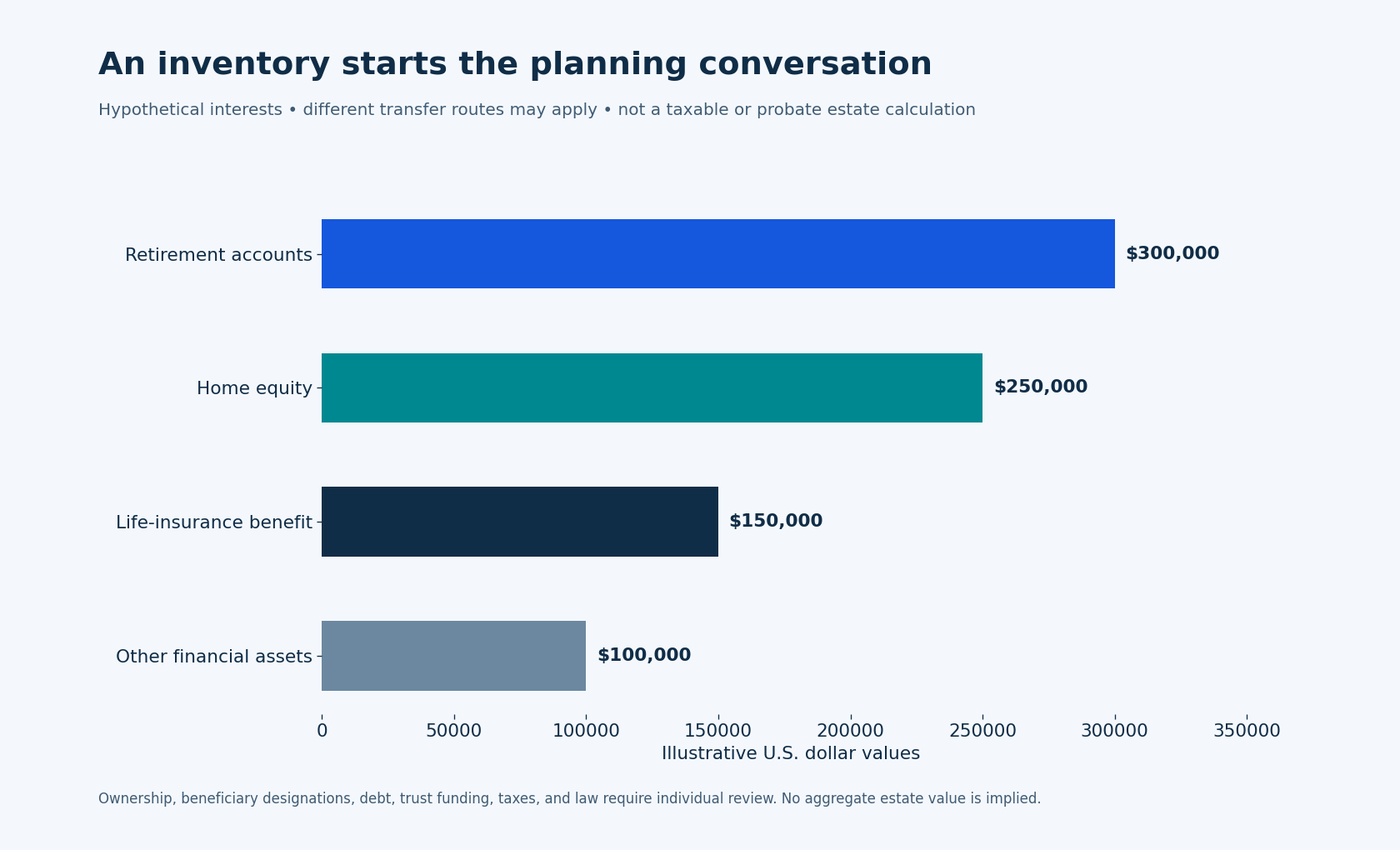
Consider a hypothetical household with $300,000 in retirement accounts, $250,000 in home equity, $150,000 in life-insurance death benefits, and $100,000 in other financial assets. Those figures describe four different interests. They do not establish taxable estate value, probate value, available cash, or the amount any beneficiary will receive.

Ownership, debt, beneficiary designations, plan terms, and applicable law determine what further work is needed. Home equity is not the same as gross real-estate value, and insurance proceeds are not an account balance available during life. The chart is an inventory illustration, with all amounts explicitly hypothetical. Its purpose is to prompt record review, not persuade every reader to purchase a trust.
Choose fiduciaries for the actual work
An executor or administrator handles an estate under court-issued authority. A trustee handles trust property under the document and law. A financial agent acts under delegated authority during the principal's life. The same person may sometimes fill more than one role, but the powers, duties, records, and reporting obligations remain distinct.
Consider reliability, availability, financial skill, impartiality, geography, cost, and family dynamics. Name backups and plan for inability or unwillingness to serve. A nominated executor generally needs appropriate court qualification; simply possessing the will does not grant unrestricted authority to use accounts or distribute assets. Fiduciaries should understand that the property is not personal money to spend informally.
Plan separately for incapacity and health decisions
A financial power of attorney addresses specified financial and property powers. North Carolina Chapter 32C supplies important rules concerning effectiveness, durability, special authority, duties, and termination. An agent cannot assume general language authorizes every gift, beneficiary change, or self-benefiting transaction. The agent's authority generally terminates at the principal's death.
A health care power of attorney, living will, and health-information release have different functions. Permission to receive information is not the same as decision-making authority. Choose someone who can communicate, understand the person's values, and act when needed. Discuss execution and access with counsel and providers. A spouse or adult child should not assume family relationship alone provides complete authority over every financial or medical decision.
Protect children and beneficiaries who need management
A will can express a guardian nomination, but the court and applicable law govern appointment, and another parent's rights matter. The person providing daily care need not necessarily be the person managing an inheritance. Consider the different skills, burdens, and cooperation the roles require.
An outright gift to a minor may create management issues and may not match the parent's goals for later distribution. Trust terms can address education, health, housing, and discretion where appropriate. For a beneficiary receiving SSI or certain Medicaid benefits, identify the actual program before making a direct gift. First-party and third-party special-needs planning involve different requirements; an informal promise by a sibling is not a reliable substitute for a properly designed arrangement.
Administration still requires attention to obligations
After death, an estate or trust may need to address records, authority, creditors, expenses, taxes, allowances, accounting, and distributions. A family agreement about who should receive money does not necessarily satisfy fiduciary duties. Premature distribution can create personal exposure or require later recovery of funds.
North Carolina provides simplified procedures for qualifying estates. Small-estate collection generally uses a $20,000 qualifying net-personal-property threshold, with $30,000 in specified surviving-spouse circumstances and additional statutory conditions, including timing. These figures are not a measure of total household wealth. Review G.S. 28A-25-1 and the related testate-estate provisions with the actual ownership and family facts.
Update the plan when life or property changes
Marriage, separation, divorce, births, deaths, disability, relocation, business changes, and a fiduciary's inability to serve can alter the plan. Divorce can affect some provisions without automatically correcting every account, beneficiary form, trust, or federal plan. Court orders and agreements may also restrict changes during a pending matter.
Review deeds, insurance, retirement designations, contingent beneficiaries, and trust funding alongside the documents. Tax thresholds and distribution rules require current advice rather than a permanent number copied from an older article. Store originals securely where the appropriate person can find them. Keep passwords in a protected separate system, not in a will that may later become a public probate record.
Make the consultation concrete
Bring existing planning documents, deeds, asset-and-debt information, beneficiary records, business agreements, and a list of goals and proposed decision makers. Ask Chris Purkey or Chris Adkins what work is included, who handles drafting and execution, whether deeds and funding assistance are included, and when tax, benefits, or other specialist advice should be coordinated. A clear scope helps ensure the plan is implemented rather than simply signed.
Call or text 704-880-9388 or contact Adkins & Purkey about an Albemarle wills-and-trusts consultation. The office is 217 W. Main Street, Locust, NC 28097. Continue with the 100 wills-and-trusts FAQs, estate planning resource, and wills-and-trusts guide. Confirm representation and the secure method for sharing private information directly with the firm.
Official sources and further reading
Legal sources checked November 11, 2026. Laws and agency procedures can change; confirm the requirements governing a specific matter.
- NC Judicial Branch: estates
- NC wills, execution, and electronic storage: Chapter 31
- NC intestacy: Chapter 29
- NC Uniform Trust Code: Chapter 36C
- NC financial powers of attorney: Chapter 32C
- NC health care powers of attorney: Chapter 32A, Article 3
- Social Security: trust and SSI information
- NC estate administration: Chapter 28A
- NC small-estate affidavits: G.S. 28A-25-1
- NC Uniform Trust Code: trustee administration and duties
Published biographies: Christopher “Chris” Adkins and Chris Purkey · Adkins & Purkey firm website
Discover more from Albemarle Law
Subscribe to get the latest posts sent to your email.