ADKINS & PURKEY, PLLC · ALBEMARLE & STANLY COUNTY
Legal sources checked November 11, 2026 · General North Carolina information
A collision, fall, or other serious injury can interrupt work, treatment, transportation, and family responsibilities at once. For someone in Albemarle, the legal questions often arrive while the immediate practical problems are still unfolding. An adjuster wants a statement. A medical bill arrives. A vehicle is declared a total loss. The injured person may not yet know whether the symptoms will improve quickly or require continuing care.
Adkins & Purkey, PLLC provides this guide to help Albemarle and Stanly County readers organize those questions. Chris Adkins and Chris Purkey serve the area from the firm's Locust office. The most useful starting point is a reliable record: what happened, what harm followed, which policies may apply, and which deadlines require action. No online article can determine the value or filing deadline of an individual injury claim.

Put health and safety first
Obtain appropriate emergency assistance and medical care. Follow clinical instructions and give providers an accurate history of symptoms, prior conditions, and the incident. A legal claim should never be the reason to delay necessary treatment or continue an activity a clinician has restricted. Lawyers evaluate legal rights; medical professionals assess diagnosis and treatment.
When safe, follow reporting requirements and collect identifying information. Photographs, witness details, location, time, weather, vehicles, and the investigating agency can help preserve the event. Do not obstruct responders or enter a hazardous area to obtain a picture. A short accurate account created close to the event can be more useful than an elaborate narrative reconstructed months later.
Injury and legal responsibility are different questions
An ordinary negligence claim generally requires duty, breach, causation, and compensable harm. Each element needs support. A serious injury does not automatically prove that a property owner or driver violated a legal duty, and proof of carelessness does not automatically connect every later symptom or expense to the incident.
Identify potentially responsible parties and the basis for each person's responsibility. A commercial vehicle may involve an employer, owner, or other entity, but a business connection alone is not enough. A fall may involve control, notice, inspections, and the condition's origin. Counsel should investigate the actual relationships and events before deciding whom to pursue or what remedy is realistic.
North Carolina's contributory-negligence rule matters
North Carolina generally applies contributory-negligence principles to ordinary negligence claims. A plaintiff's own legally contributing negligence can bar recovery. That makes evidence about lookout, speed, right of way, warnings, and the sequence of events particularly important. The analysis is not simply an adjuster selecting a small percentage and announcing that the case is over.
Exceptions and related doctrines, including last clear chance and questions involving willful or wanton conduct, have specific requirements. They should not be promised merely because an injury is severe. The North Carolina Department of Insurance's accident guidance explains the general significance of contributory negligence. A disputed fault allegation still deserves review against the available evidence and governing law.
A crash report is a starting point
Police reports may contain useful diagrams, observations, identifying information, and recorded accounts. They can also include statements the officer did not personally observe. Admissibility and the legal significance of particular portions require analysis. A citation, charge, or officer's conclusion should not be treated as a complete civil-liability decision.
Preserve the report along with photographs, witness contacts, dashcam footage, business surveillance, repair records, and relevant vehicle data. Some recordings are overwritten quickly. Chris Adkins's published biography identifies prior police and military service and an interest in careful investigation. That background informs the questions asked, while reconstruction, medical causation, and specialized issues may still require qualified experts and independent evidence.
Statewide crash data provide context, not a case prediction
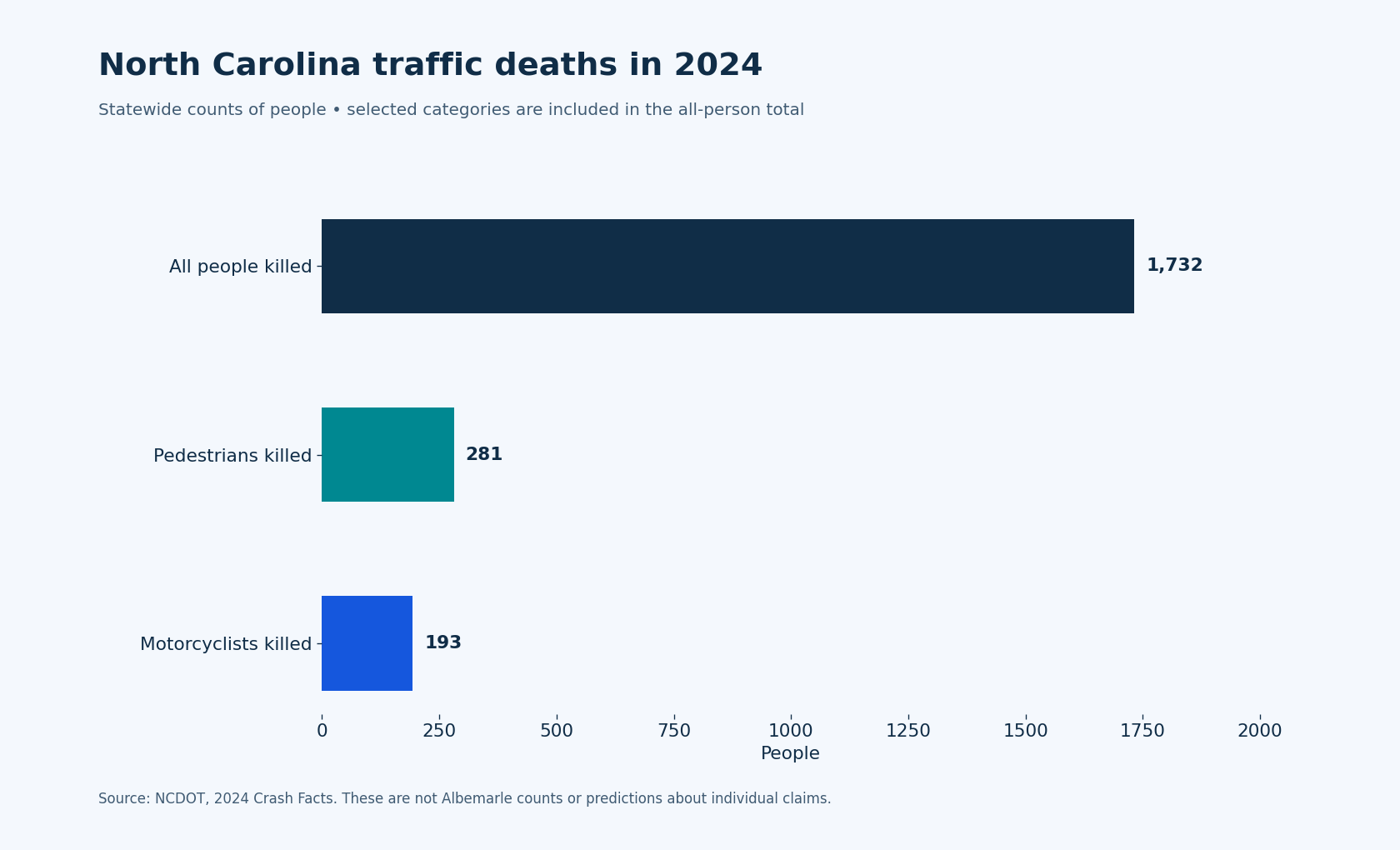
NCDOT's 2024 Crash Facts report records 284,546 traffic crashes, 113,602 people injured, and 1,732 people killed statewide. These are North Carolina totals for a specified year, not Albemarle counts and not measurements of the likelihood that a particular claim will succeed. The report also identifies 281 pedestrian deaths and 193 motorcyclist deaths in 2024.

The chart compares selected categories of people killed, all measured in persons for the same year. It does not add those categories to the statewide total or compare people directly with crash events. The official NCDOT report supplies the figures. Reliable statistics explain the scale of roadway harm; they do not establish fault, damages, or the value of a private case.
Read the insurance policies and their effective dates
Liability insurance may cover a legally responsible insured, subject to limits, exclusions, and conditions. Uninsured and underinsured coverage can raise separate rights and procedures. Household, passenger, employer, and other policies may require examination. An insurance card does not disclose the entire contract or resolve which provisions apply.
For applicable North Carolina policies issued or renewed on or after July 1, 2025, minimum liability limits increased to $50,000 per person and $100,000 per accident for bodily injury, and $50,000 for property damage. The legislation also changed underinsured-motorist coverage. See the Department of Insurance's explanation. The actual policy date, terms, purchased limits, and claim circumstances remain essential; a minimum limit is not a promised settlement.
Be deliberate about statements and authorizations
Your own insurance policy may require timely notice and cooperation. Those duties are different from assuming you must give the opposing insurer any requested recorded statement or unrestricted medical authorization. Read the request, identify the requesting party, and seek advice when the scope or consequences are unclear.
Provide truthful information and avoid speculation. An injured person may not yet know the prognosis or whether all symptoms are connected to the event. Saying that treatment is continuing is different from guessing at a permanent diagnosis. Keep copies of forms, statements, letters, and submissions so counsel can assess exactly what was communicated and what obligations remain.

Keep property damage and bodily injury coordinated
A vehicle claim can involve repair costs, total-loss valuation, rental expenses, loss of use, loan payoff, and GAP coverage. The vehicle's covered value is not necessarily the amount owed on its loan. Review the valuation report and accurate comparable information rather than assume the insurer must pay the lender's full balance.
Property damage and bodily injury concern different losses, but release language can connect them. Read any settlement document before signing and confirm which claims it resolves. An offer that appears to pay only for a vehicle should not be accepted without understanding whether the paperwork releases broader rights. Keep repair, rental, towing, storage, and loan records organized separately from treatment records.
Document treatment without turning care into a litigation exercise
Accurate records establish reported symptoms, examinations, findings, treatment, restrictions, and progression. Tell providers about earlier injuries and relevant conditions. A preexisting problem does not necessarily eliminate a claim for a supported aggravation, but concealment or an inaccurate history can seriously damage both medical assessment and credibility.
Treatment gaps may require explanation, including access, expense, improvement, scheduling, or clinical advice. Keep a factual record of the reason rather than invent an explanation later. A recovery journal can describe specific tasks and limitations, but it may be discoverable. Medical care should follow clinical need; accumulating visits solely to make a claim look larger is neither a sound treatment plan nor reliable evidence.
Build a damages file with clear categories
Potential compensable losses can include medical expenses, lost earnings, diminished earning capacity, pain, and other legally supported harm. Each category requires causation and proof. A spreadsheet is an organizing tool, not a substitute for determining whether an expense is recoverable under North Carolina law.
| Record category | What it helps explain |
|---|---|
| Medical records and itemized bills | Treatment, history, restrictions, charges, and causation questions. |
| Payroll and employer verification | Dates, hours, and earnings actually lost. |
| Business records for self-employment | Income loss after distinguishing receipts and expenses. |
| Clinical prognosis and qualified expert evidence | Supported future care or earning-capacity questions. |
| Factual daily-life records | Specific effects on activities and functioning. |
Avoid a universal pain-and-suffering multiplier. NCDOI explains that state statutes do not supply a standard formula for every such amount. Liability, injury evidence, prognosis, credibility, coverage, and litigation risk can change an evaluation materially.
Gross settlement and net recovery are different
An offered amount is not necessarily the amount the injured person will receive. Fees, litigation costs, unpaid bills, valid liens, and reimbursement rights can affect the distribution. Medicare, Medicaid, employer health plans, and providers may have different legal interests. They should not be combined into one unexplained deduction.
Ask for an itemized estimate identifying known amounts, disputed obligations, and remaining uncertainty. A reduction should not be promised until the relevant party agrees or the law establishes it. A release of the defendant does not automatically eliminate a health plan's rights. Benefit eligibility can also require planning before money is received, especially when the injured person receives means-tested assistance.
Deadlines require review before treatment ends
Many ordinary North Carolina negligence injury claims fit a three-year statutory framework, while wrongful death generally involves a two-year framework with additional statutory conditions. Those broad descriptions are not a deadline calculation. Accrual, age, claim type, professional malpractice, governmental defendants, notice, and repose rules can produce important differences.
Negotiating with an adjuster does not generally stop a filing clock. A work injury can involve workers' compensation notice and claim requirements as well as a potential third-party action. Medical malpractice can require qualified review and procedural certification. Tell counsel the event date, defendants, treatment history, and every notice promptly so preparation time is considered before any deadline approaches.
Litigation, mediation, and a realistic strategy
Some injury matters resolve through negotiation; others require a lawsuit, discovery, expert testimony, mediation, or trial. Discovery may involve sworn testimony and relevant private records, subject to legal limits. Preserve information and be candid with counsel. Deleting social media, altering photographs, or coaching a witness can create new problems that do not improve the underlying claim.
A useful settlement discussion compares supported damages, fault disputes, coverage, collection, expenses, timing, and net recovery. The mediator does not decide who wins. Ask Chris Adkins or Chris Purkey about the available representation, proposed investigation, fee structure, cost responsibility, and realistic uncertainty. A responsible strategy should explain what additional information would change the assessment.
Special attention for children and families
An injured adult ordinarily makes their own legal decisions unless another person has appropriate authority. A spouse or parent who helps gather records does not automatically have authority to sign a settlement. If the injured person cannot act, powers of attorney, guardianship, or other legal arrangements may need review. Keep the decision maker's authority separate from the family's practical support role.
Claims involving children can require special representation and court approval of a settlement. Proposed fees, expenses, distribution, and protection of funds need careful attention. A parent should not assume a private signature conclusively binds every right of the child. If an injured person has died, estate authority, survival claims, and wrongful-death rights must be assessed through their own rules.
Read the attorney agreement before relying on a fee assumption
If a contingency arrangement is offered, ask about the percentage, when it changes, the scope of work, and responsibility for expenses. Records, experts, filing, and depositions can affect costs. Confirm what happens if the matter ends without recovery and whether an appeal or related benefits proceeding is included. A written agreement and a clear explanation of potential net recovery are more useful than assuming every personal injury case follows identical terms.
Preparing for an Adkins & Purkey consultation
Bring the incident report, photographs, witness details, insurance policies and letters, treatment information, bills, wage records, and any proposed release or court papers. A concise chronology helps connect the documents. Do not send medical records or identification through a public chatbot; ask the firm for a secure private method.
Call or text 704-880-9388 or contact Adkins & Purkey about an Albemarle personal injury consultation. The office is 217 W. Main Street, Locust, NC 28097. Explore the 100 personal injury FAQs and personal injury practice guide for additional preparation. Confirm that representation has been accepted and who is responsible for each urgent step; a website inquiry does not notify an insurer or file a case.
Official sources and further reading
Legal sources checked November 11, 2026. Laws and agency procedures can change; confirm the requirements governing a specific matter.
- NC Department of Insurance: after an accident
- NC injury limitation framework: G.S. 1-52
- NC Department of Insurance: July 2025 insurance changes
- NC auto liability and UM/UIM statute: G.S. 20-279.21
- NC punitive damages standards: G.S. 1D-15
- NC wrongful-death and survival claims: Chapter 28A, Article 18
- NC Industrial Commission: workers compensation information
- NC product liability: Chapter 99B
- NC medical provider liens: Chapter 44, Article 9
- NC civil procedure rules
- NCDOT: 2024 Crash Facts
Published biographies: Christopher “Chris” Adkins and Chris Purkey · Adkins & Purkey firm website
Discover more from Albemarle Law
Subscribe to get the latest posts sent to your email.