ADKINS & PURKEY, PLLC · ALBEMARLE & STANLY COUNTY
Legal sources checked November 11, 2026 · General North Carolina information
Receiving a citation, warrant, or other criminal charging paper can make the next few days feel uncertain. The questions are immediate: must I appear, can I drive, may I contact someone involved, and what should I say if an investigator calls? For Albemarle and Stanly County residents, the best first step is to organize the actual documents and obtain advice before assuming that an apparently small charge has only small consequences.
This Adkins & Purkey, PLLC guide explains how to prepare for a criminal-defense consultation and understand the separate decisions that can arise. Chris Adkins and Chris Purkey serve Albemarle from the firm's Locust office. The information is general; it does not predict a private case, replace an active order, or establish that a lawyer has entered an appearance.

Read every charge and every condition
Begin with the complete citation, warrant, indictment, summons, release order, and hearing notice. A single paper can list multiple charges, and a case can involve more than one file number. An infraction, misdemeanor, and felony do not necessarily follow the same procedure or carry the same consequences. A traffic-related charge can also have criminal and licensing effects.
Record the listed court date and any requirements concerning contact, travel, monitoring, weapons, or other conduct. Do not assume posting bond ended the case or that an alleged victim's invitation changes a no-contact restriction. The order's actual language controls until it is properly modified. A consultation request does not excuse an appearance or authorize conduct prohibited by the court.
Understand the roles of the participants
The prosecutor represents the State in a criminal proceeding, while defense counsel advises and advocates for the accused. An alleged victim can provide information and express a position, but does not independently control the prosecutor's legal decisions. Asking someone to drop charges is therefore not a substitute for evaluating the evidence and lawful options.
The judge has a different role again, including decisions assigned by law about procedure, release, evidence, and disposition. A defense lawyer cannot promise influence over a judge or prosecutor. The useful discussion concerns the charged elements, admissible evidence, available defenses, procedure, and the client's informed decisions. The Judicial Branch's criminal-case guide explains the general court structure and process.
District Court and Superior Court have different functions
Misdemeanors and infractions are generally handled in District Court. Felony cases often begin there for preliminary matters, while felony trials occur in Superior Court. Certain cases can follow additional authorized routes. The first appearance is therefore not necessarily a trial, and the location of an early hearing does not by itself establish how the entire matter will proceed.
Ask counsel what the next setting is expected to address, whether attendance is required, what records should be available, and what decisions may arise. Keep later notices and charging documents. A change in the prosecution's allegations or a new court order can alter the preparation needed, even when the original case number remains familiar.
Police contact requires careful, lawful decisions
A person can have rights concerning silence, counsel, consent, and interrogation while also having lawful obligations in particular encounters. The setting matters. A voluntary interview, a roadside stop, custodial questioning, and execution of a warrant do not all present identical choices. Calmly asserting an applicable right is different from resisting, obstructing, or giving false information.
Miranda warnings concern custodial interrogation and related requirements; they are not required before every police conversation. Their absence does not automatically dismiss a case. Similarly, declining consent does not prevent a search supported by a warrant or another lawful exception. Give counsel a precise account of what was said, asked, signed, and done so any issue can be evaluated through the proper procedure.
Preserve the record before it disappears
Tell counsel about body-camera footage, dashcam video, business surveillance, messages, location data, receipts, photographs, and witnesses. Identify the date, time, device, and location as specifically as possible. Some systems overwrite recordings quickly. Preservation requests and lawful access procedures may need attention before a later hearing.
Do not delete relevant messages, edit an image to make it more persuasive, access another person's account without permission, or pressure a witness. A person with useful information should be identified without coaching a shared account. Ordinary jail calls and messages should not be assumed confidential. Use appropriate attorney communication channels and discuss the case privately with counsel rather than through public posts or group messages.
Connect evidence to the charged elements
A defense review asks what the State must prove and which evidence bears on each element. A witness may be sincere yet mistaken. A video may start late or omit another angle. A laboratory result, identification procedure, search, or statement can raise questions that require technical review. No single dramatic fact should replace examination of the full record.
Chris Adkins's published biography identifies prior service as a Charlotte-Mecklenburg police officer and U.S. Army officer. Those experiences can inform an interest in investigative detail and organized evidence. They do not replace the governing law, qualified expert analysis, or the facts of an individual case. Ask how any relevant experience would connect to the actual work proposed by Adkins & Purkey.

Discovery and motions serve different purposes
Criminal discovery concerns information disclosed under procedural and constitutional requirements. Counsel should review what exists, what has been produced, what may be missing, and what lawful additional requests are available. Receiving an initial packet is not necessarily the end of evidence review. The scope and timing depend on the charge and procedural stage.
A motion seeks a particular court ruling. A suppression motion, for example, may ask to exclude evidence under a supported legal basis. Procedural deadlines, factual findings, and the remedy matter. A successful challenge to one item does not automatically eliminate every charge, while a lost motion does not by itself answer all remaining trial issues. Strategy should connect the requested ruling with its practical consequence.
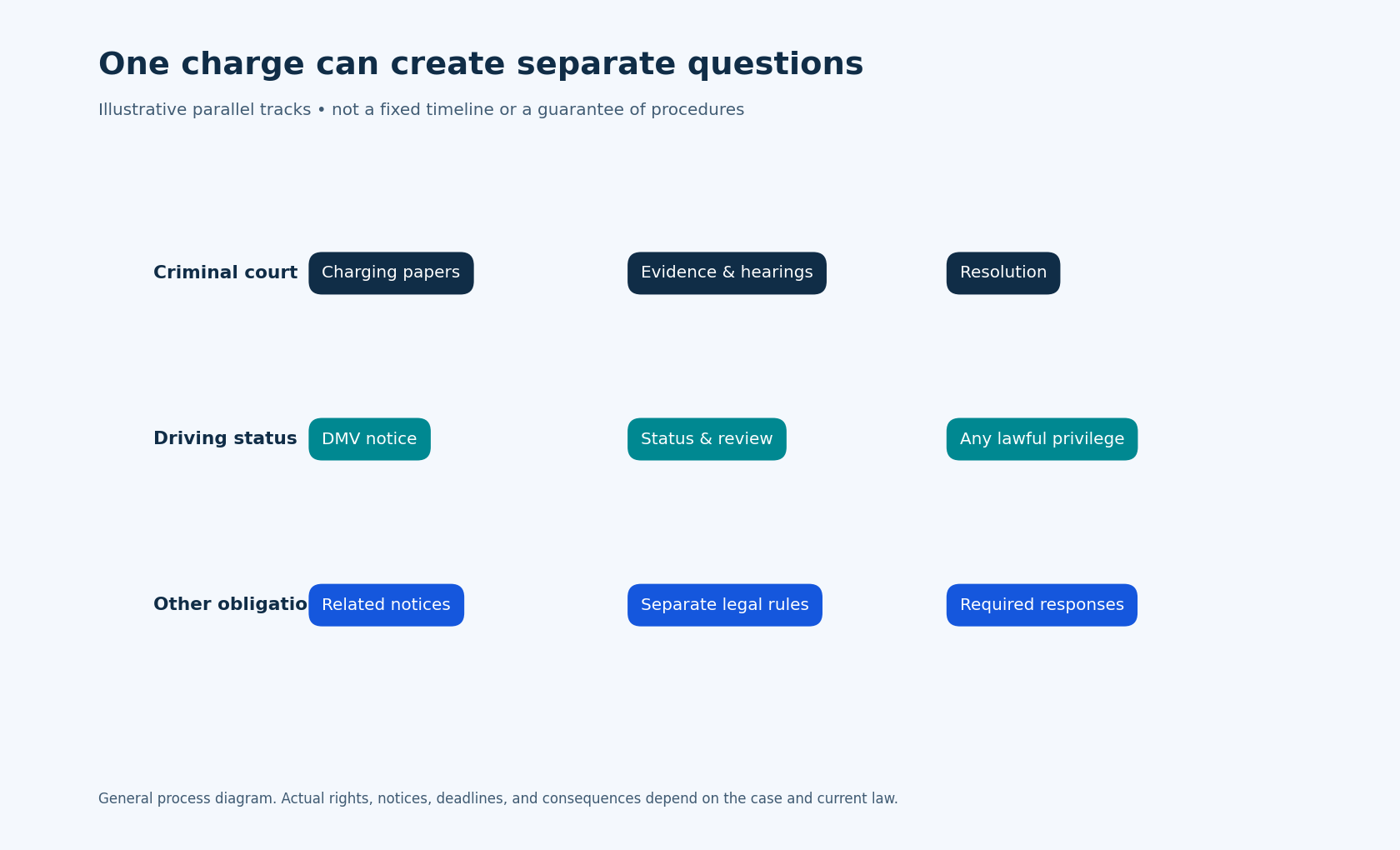
Keep parallel consequences on separate tracks
A criminal charge can create issues in DMV proceedings, employment, licensing, immigration, custody, protective orders, or military obligations. These systems can apply different definitions and deadlines. A disposition that reduces an immediate court penalty may still have serious consequences elsewhere. Tell counsel about relevant licenses, citizenship concerns, current orders, and employment requirements early.

| Track | Records to identify | Question for counsel |
|---|---|---|
| Criminal court | Charging papers, release orders, discovery, hearing notices | What must be proved, and what is the next required step? |
| Driving privileges | DMV notices, license history, privilege orders | Is driving authorized now, and is separate review required? |
| Other proceedings | Licensing, immigration, employment, family-court, or agency notices | Which additional rules or professional advice must be coordinated? |
The chart is a process illustration, not a promise that every defendant has all three tracks or that events occur in a fixed number of days.
DWI is more than an alcohol-concentration number
North Carolina impaired-driving law includes impairment-based provisions as well as specified alcohol-concentration provisions. For ordinary adult noncommercial driving, 0.08 is an important statutory threshold, but a lower number does not automatically establish innocence. Commercial driving, drivers under 21, controlled substances, and particular facts can raise different rules.
Chemical-test refusal and certain immediate license consequences can create separate review questions before the criminal case ends. A possible limited driving privilege is not the same as an effective privilege actually issued on appropriate terms. Do not drive while revoked based on an assumption that a lawyer will later obtain permission. Bring all DMV and implied-consent papers promptly so deadlines and present status can be assessed.
Paying a traffic citation is a legal decision
Payment of a waivable citation generally has the effect of admitting guilt or responsibility for the listed violation. DMV points, insurance rating, commercial-license consequences, and employment obligations can differ. A small fine is not a reliable measure of the full impact. Review every charge rather than treat an online payment page as an indication that no legal advice could be useful.
North Carolina changed aspects of insurance rating effective July 1, 2025, including specified lookback and surcharge rules. Dates, offense details, household history where relevant, and later legal changes require current review. See NCDOI's explanation. A prayer for judgment continued is not universally equivalent to a dismissal and should not be chosen by slogan.
Evaluate plea offers with the full consequences in view
A plea agreement can involve a guilty plea in exchange for specified concessions or proposed terms. The defendant needs to understand what is binding, what remains discretionary, what the court must approve, and what happens if the proposed disposition is not accepted. The decision should be informed and voluntary, with counsel explaining evidence, defenses, sentencing exposure, and alternatives.
Ordinarily, a guilty plea to a criminal offense results in a conviction unless a particular authorized deferral or conditional-discharge process changes the eventual outcome. Probation does not itself mean there is no conviction. Ask about conditions, violations, record effects, and consequences outside court before deciding. A favorable-sounding label cannot substitute for reading the actual agreement and judgment.
Diversion and expunction require statutory eligibility
Deferred prosecution and conditional discharge may be available in qualifying circumstances, often with requirements concerning treatment, conduct, restitution, or other conditions. They are not automatic for every first offense. Eligibility, admissions, completion, and consequences of a violation need individual review. Keep the signed terms and proof of compliance.
Dismissal and expunction are different concepts. Current statutes govern whether a record qualifies for automatic or petition-based relief, applicable exclusions, waiting periods, and required procedures. Expunction also does not necessarily erase every private record or eliminate every federal consequence. The Judicial Branch's expunction resource links to statutes and forms. Use an accurate record and current law rather than an old checklist.
Prepare for sentencing without assuming one universal chart
North Carolina uses different sentencing frameworks for felonies, misdemeanors, impaired driving, and particular offenses. Offense class, prior convictions, statutory scoring, aggravating or mitigating circumstances, and special provisions can affect exposure. A remembered description of an old case may be inadequate; counsel may need the actual judgment and underlying offense information.
Treatment, employment, family obligations, restitution, and other circumstances may be relevant within the applicable framework. They should be documented accurately rather than presented as a guaranteed way to avoid a particular sentence. A court's authority and required findings still matter. Ask what evidence should be obtained, who can explain it, and which decisions remain uncertain.
Know what an appearance or continuance requires
Confirm the date, courthouse, courtroom, attendance requirements, and security procedures. The official Stanly County Courthouse listing identifies 201 S Second Street, Albemarle. Current court-date resources and counsel should be used for the actual setting. An online search should not be interpreted as permission to disregard a written notice without clarification.
A requested continuance is not an approved continuance. Illness, travel problems, or inability to attend should be raised promptly with counsel so lawful procedures can be considered. Missing court can create additional consequences. Retaining an attorney does not automatically excuse personal attendance, and a change in one case does not necessarily change another criminal file or a DMV hearing.
Ask clear questions about representation and cost
An engagement should identify the client, attorney, charges or proceedings included, fees, expenses, and communication expectations. Trial, appeal, experts, licensing, and related family matters may require separate arrangements. A family member paying the fee does not automatically become the client or receive every confidential communication.
Ask Chris Purkey or Chris Adkins about relevant experience, the first records needed, immediate deadlines, and the likely next decision. Adkins & Purkey should discuss uncertainty candidly rather than guarantee dismissal or special treatment. If appointed counsel is relevant, the court determines eligibility under the applicable standards; a private consultation is a different arrangement.
Requesting help from Adkins & Purkey
Call or text 704-880-9388 or contact Adkins & Purkey about a criminal-defense consultation serving Albemarle and Stanly County. The office is 217 W. Main Street, Locust, NC 28097. Bring every charging and release document, court notice, DMV letter, prior relevant order, and a concise chronology. Use a private approved transfer method for sensitive material.
The 100 criminal-defense FAQs, criminal practice guide, and DWI and traffic resource provide additional context. Confirm representation, appearance obligations, and responsibility for deadlines directly. Albie can help locate a published guide, but cannot enter an appearance, change a release condition, or authorize driving.
Official sources and further reading
Legal sources checked November 11, 2026. Laws and agency procedures can change; confirm the requirements governing a specific matter.
- NC Judicial Branch: criminal cases
- NC criminal procedure: Chapter 15A
- NC criminal law: Chapter 14
- NC pretrial release: Chapter 15A, Article 26
- NC criminal discovery: Chapter 15A, Article 48
- NC Judicial Branch: sentencing resources
- NC Judicial Branch: expunctions
- NC impaired-driving statute: G.S. 20-138.1
- NC Judicial Branch: traffic violations
- NC Judicial Branch: Stanly County Courthouse
Published biographies: Christopher “Chris” Adkins and Chris Purkey · Adkins & Purkey firm website
Discover more from Albemarle Law
Subscribe to get the latest posts sent to your email.